July 25 | Moments Almanac | Imago
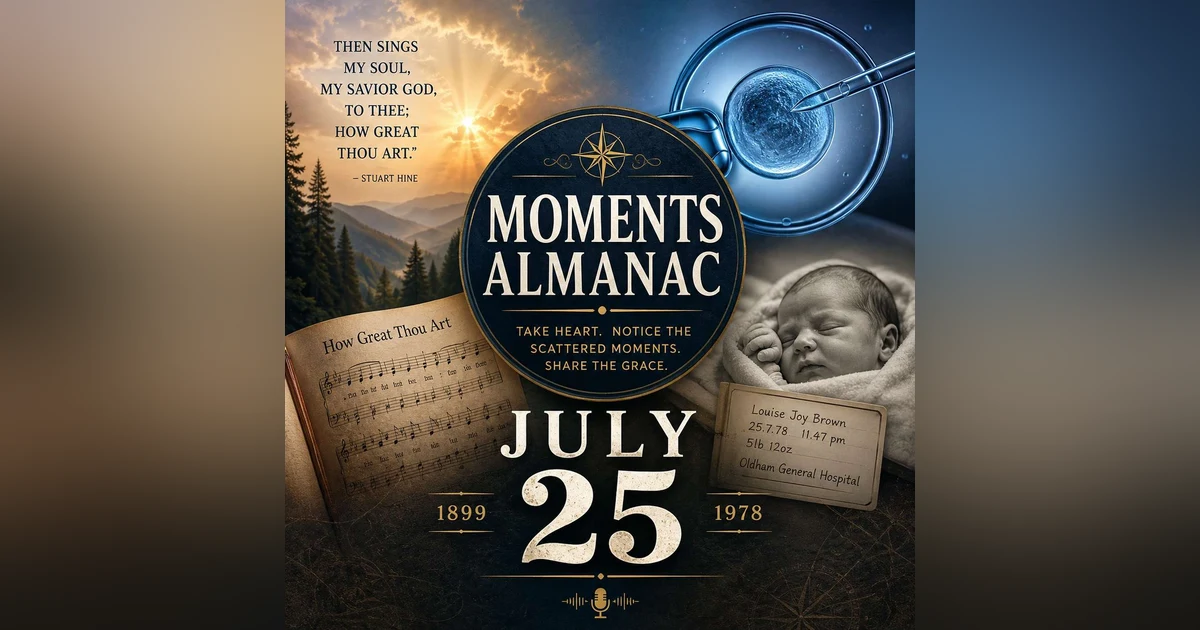


On July 25, two remarkable moments—separated by seventy-nine years—invite us to stand in awe of the mystery of human life.
In 1899, Stuart K. Hine was born in London. His missionary journeys through the Carpathian Mountains would eventually lead him to translate and expand the beloved hymn "How Great Thou Art," a song that celebrates the majesty of God's creation and the God who knows each human soul.
Then, on July 25, 1978, Louise Joy Brown entered the world as the first child conceived through in vitro fertilization. Her birth marked a turning point in medical history and sparked conversations that continue to this day about science, ethics, and the gift of life.
Rather than offering easy answers, this episode invites us to recover something often lost in our debates: wonder. From mountain hymns to hospital rooms, every human life ultimately points beyond itself to the Creator who forms us, knows us, and calls us His own.
"Then sings my soul, my Savior God, to Thee: How great Thou art!"
This is Moments Almanac on Scattered Moments. Today is July 25th, and July 25th holds two moments about the same subject, human life and where it comes from. In 1899, in a working-class flat in Fulham, London, a boy named Stuart Hine was born to no particular fanfare at all. He grew up faithful to the Salvation Army services his parents took him to, and at 14, he made his own decision to follow Christ. Decades later, he carried that decision onto the road as a missionary, first through the Carpathian mountains of what is now Western Ukraine, then Poland, then Czechoslovakia and Romania. It was in those mountains that Hine first heard the Russian translation of an old Swedish hymn, one that did nothing but stand in front of creation and marvel at it. He couldn't shake the truth, and over the years of evangelistic travel he turned it into English, adding verses of his own as he later watched refugees stream past him during the Second World War. The hymn became How Great Thou Art, verses that looked at the stars, the woods, the birds, and the thunder, and then at the astonishing truth that God, the one God who made all of it, also bends down to a single soul. Then sings My soul, my Savior God to thee, how great thou art How great thou art. Now let's travel to another july twenty fifth, seventy nine years later. On that same date, a different kind of wonder happened in a hospital in Oldham, England. At eleven forty seven at night, a baby girl named Louise Joy Brown was delivered by Caesarean Section, weighing five pounds twelve ounces, ordinary in every way but one. She was the first human being ever conceived outside the mother's body, the result of years of work by physicians and researchers seeking to help women with blocked fallopial tubes become mothers. The press called her a test tube baby, and the world reacted about how you'd expect them to react. Reporters camped outside the hospital. Ethicists debated on television, and more than a few church leaders warned that humanity had stepped into territory belonging to God alone. Louise Brown grew up anyway. She married, had two naturally conceived children of her own, and lived a life about as unremarkable as Stuart Hines had been before the mountains of Ukraine. So what's the connection with these two stories? One story is about a man learning to stand back and marvel at what God's hands had already made. The other one is about physicians entering one of the deepest mysteries of creation itself. Scripture doesn't tell us everything we wish it would about modern medicine, but it tells us something deeper. Psalm 139 says this, for you formed my inward parts. You knitted me together in my mother's womb. Every human life bears the image of God. Every child is known by him before anyone else knows his or her name. As Francis Collins, a geneticist and Christian, declared, the God of the Bible is also the God of the genome. He can be worshipped in the cathedral or in the laboratory. I kind of see July twenty fifth as an invitation. The wonder Stuart Hine wrote about was never rooted in understanding everything God does. It was rooted in standing before his works with humility and awe. Every birth, however it happens, however many hands helped along the way, still carries something no laboratory can manufacture and no science can claim as his own, a person, an image-bearer of God, a soul fashioned for purposes known fully only to its creator. So before we rush to settle every argument, perhaps we should recover our capacity to marvel. Then sings my soul. That's Moments Almanac for July twenty fifth. I hope you'll join me tomorrow. Until then, take heart. Notice the scattered moments, and share the grace.


