I Know How You Feel
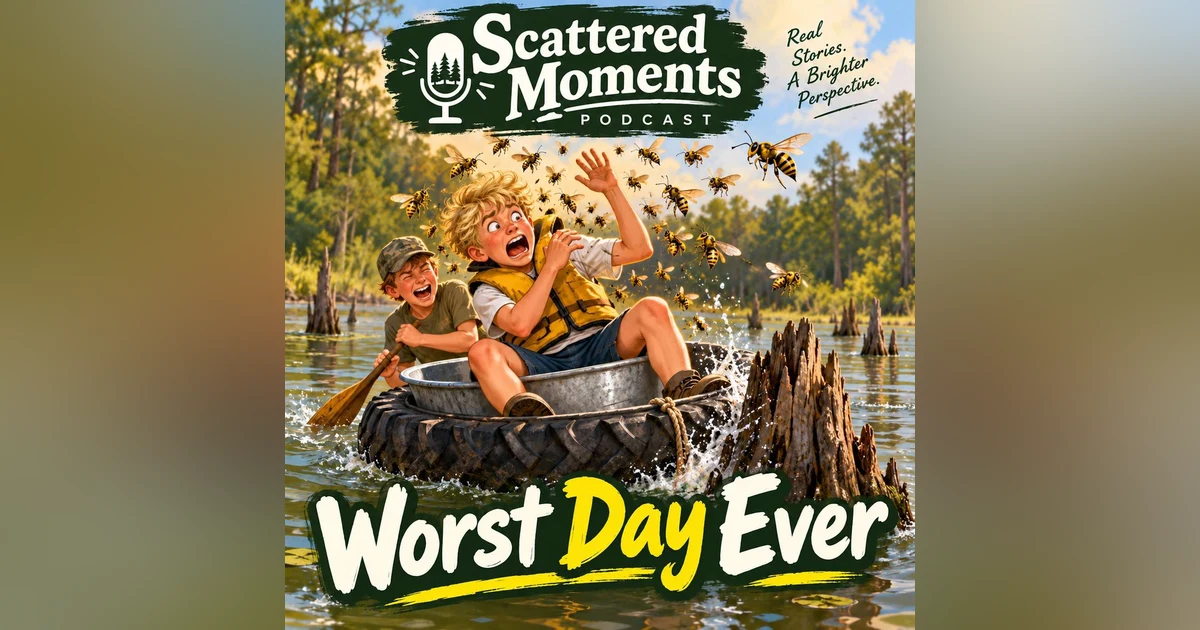


What do yellow jackets, a homemade tractor-tire boat, the first day of junior high, and forgetting where you live have in common?
In this episode of Scattered Moments, I look back on one of the most embarrassing and unforgettable days of my childhood—and the surprising gift it left behind. Sometimes suffering gives us a language for compassion. It teaches us how to sit beside someone else and say, “I know how you feel.”
And that points us to something even greater: Jesus doesn’t understand our pain from a distance. He entered it. He knows weakness, rejection, grief, loneliness, and suffering from the inside.
The worst days can leave scars. But sometimes those scars become reminders that we are not alone—and that God can even use painful moments to make us more tender toward others.
Welcome to Scattered Moments. This one's called I Know How You Feel. There are bad first days of school, and then there are first days of school that seem personally designed by a committee whose sole purpose is to destroy a seventh grader. And I had one of those days. It happened at the end of the summer just before my first year of junior high school. My dad had gotten a new job in another city, and during the week before school started, my family was right in the middle of moving. Now the great thing about being a kid during a move is that adults sometimes decide that the most helpful thing that you could do is disappear. And so they shuffled me off to my grandparents' house in central Louisiana, far enough out in the sticks that there was absolutely no danger of anyone asking me to carry a box. Hallelujah. My grandparents had a little house in the woods, a ten acre pond, and a cousin who lived nearby, which for a kid was paradise. The day before school started, my cousin and I decided we'd go fishing. We had we had what generously could be called a boat. It consisted of a tractor tire and a metal tub. Yes, somewhere in my family tree, apparently there is a branch occupied entirely by people who looked at discarded farm equipment and said, you know what? That could float. So there we were, navigating this pond in our homemade maritime masterpiece, winding our way through dead trees, sticking up in the water, and then we hit a stump, not just any stump, a stump filled with yellow jackets, and apparently these yellow jackets had been waiting all summer for something to happen. And we were that something. The swarm came out like one of those plagues of Egypt. My cousin and I abandoned ship, we dove straight into the pond, which was an excellent plan, except that yellow jackets do not respect emergency water landings. They got me and they got me primarily on the head. By the time the adventure was over, I looked like the elephant man with measles. My forehead was covered with swollen red stings, my face was puffy, my head looked like somebody had overinflated it, and the next morning was the first day of junior high at a new school, in a new town, where I knew absolutely nobody. Perfect. My grandmother drove me across the state and dropped me directly in front of the school, and I walked inside looking like I had lost a fist fight with a beehive. You know how seventh graders are. They're famous for their compassion, tenderness, their ability to overlook physical abnormalities, so naturally my head became something of a conversation piece. And believe it or not, I still have a few tiny scars on my forehead from that day. But the day wasn't finished yet with me. After school, I got on the bus to go home, and there was just one small problem. I had forgotten my new address completely. I didn't know where I lived. So I sat there looking out the window trying to recognize a neighborhood I had barely seen. Finally I thought, well, this looks about right, and so I got off. It was not right. So now I was a thirteen year old kid wandering around a strange neighborhood in a strange town trying to summon the courage to knock on the door of a stranger and say, Hello, I don't know where I live. May I use your telephone? And remember, I still look like ET after an allergic reaction. Eventually I found someone who let me call home, and eventually somebody came and got me. But at the time I remember thinking, this may be the worst day of my life, and maybe up until that day it was. But here's the strange thing about bad days. Sometimes they give you something. Years later my own children came home from school after being embarrassed and left out and felt humiliated, or after one of those days when it felt like the entire world had conspired to make them miserable, and I had a story. I didn't have to sit there and say, Wow, that must be tough. I could say I know how you feel. I've had days when I've wanted to disappear. I've had days when I felt ridiculous. I've had days when I've wanted to get off the bus and somehow ended up in the wrong place. Maybe that's one of the gifts of suffering. It gives us the ability to sit beside somebody else in theirs, and that is one of the things that I love most about Jesus and the gospel. The Gospel doesn't tell us that Jesus looks down from heaven at human suffering and says, Wow, that must be difficult. The Gospel tells us that he came here. Hebrews says we do not have a high priest who is unable to sympathize with our weaknesses. Jesus knows what it's like to be tired, he knows what it is to be hungry, he knows rejection, he knows grief, he knows betrayal, he knows loneliness, he knows what it is to be misunderstood, and ultimately he knows suffering, not from a distance, but from inside. We don't worship a God who stayed safely removed from the pain of the world. He entered it. Isaiah gives us this beautiful promise. When you pass through the waters, I will be with you. When you walk through the fire, you will not be scorched. Notice what God doesn't say. He doesn't say there will never be waters. He doesn't say there will never be fire. He says, I will be with you. There are some things God doesn't keep from us. He carries us through them. And sometimes years later we discover that even a terrible day left something behind a little compassion, a little tenderness, a little less judgment towards somebody who's struggling. The ability to sit beside another person and say, I know how you feel. And perhaps somewhere in your life right now, there is a worse day. Maybe nobody around you completely understands it. Jesus does. And he isn't standing far away offering advice. He draws near. He has entered our suffering. He bears the scars to prove it. And maybe that's the gospel for today. Whatever road you're walking, whatever water you're passing through, whatever strange neighborhood you have gotten yourself lost in, you're not walking alone. Jesus is with you. And when you tell him what hurts, you're praying to someone who can say, I know. In fact, that's what we should think about when we look up at crosses on churches and in our homes. It should be a symbol to us of our redemption, yes, but also the simple truth that there is a God who whispers, I know how you feel. And that is good news.


