He Just Kept Going
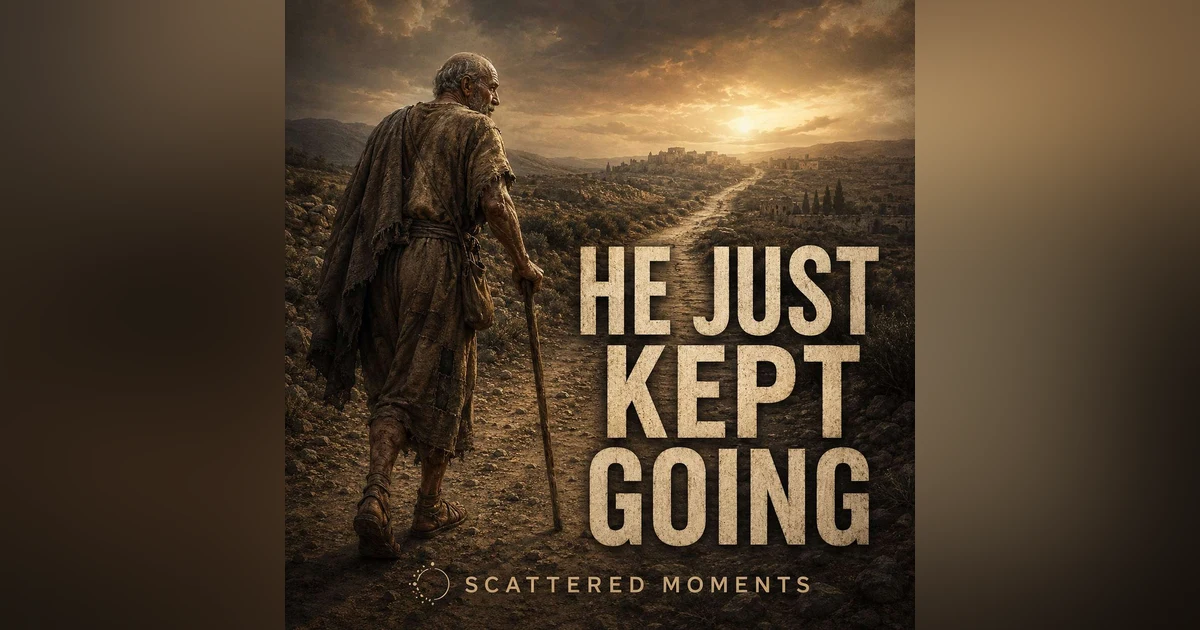


Paul was beaten, shipwrecked, imprisoned, abandoned, bitten by a snake, lowered from a city wall in a basket—and somehow, he just kept going.
But Paul’s story isn’t really about toughness. It’s about discovering that Christ is worth more than everything we might lose along the way.
In this Scattered Moments reflection, we follow the battered apostle down the long road from Damascus to Rome and discover a grace for our own difficult journeys: You don’t have to call the shipwreck good. You only have to trust that Christ is still with you in it.
Welcome to Scattered Moments, and I have a confession. Whenever I begin thinking I've got it bad, I have this annoying habit of remembering Paul. Paul of Tarsus would be an absolutely terrible guest at your next pity party. You'd start telling your story. My boss gave me an ugly look, and my last idea got shut down in half a minute. The room grows quiet, and Paul says, Really? And suddenly, you don't want to talk about it anymore. Before Jesus, Paul seems to have had a pretty good thing going. He was educated, a Roman citizen, trained under Gamaliel. He was respected. Respected enough to be entrusted with official business against this troublesome new sect of people who insisted that a crucified carpenter from Nazareth had risen from the dead. Paul was going places. And then that trip to Damascus, that changed everything. Imagine meeting Jesus for the first time, and the first thing he says is essentially, Why are you persecuting me? That's a reality check. Paul had spent his life being absolutely certain that he was on God's side, only to discover that he had been fighting against God. And then he went blind. Now he knew the truth, but he couldn't find his stuff. Eventually Paul got his ice high back. That's good. His entire life fell apart. That's bad. And thus began one of the strangest roller coaster rides in history. Paul traveled thousands of miles without airports or interstates or Ubers or GPSs or a series saying recalculating. He walked, he rode, he sailed. One of the ships sank. That's bad. He survived, that's good. He made it to shore. That's great. He got bitten by a venomous snake. That's bad. He survived that too. At some point you begin to suspect that even Paul wondered what was coming next. But he kept going. He was beaten with rods. He kept going. Five times he received the thirty-nine lashes. He kept going. He was stoned and left for dead. Yep, he kept going and he kept going. He escaped one city by being lowered over the wall in a basket, which is probably not the sort of exit strategy that they taught him under Gamaliel. But he kept going. Friends abandoned him. Churches disappointed him. Religious leaders hated him. Government officials imprisoned him, and Paul kept going. He sang hymns in jail, he preached until midnight, and one unfortunate fellow named Eutychus fell asleep, fell out of the window, and died. Paul went downstairs. The young man came back to life, and Paul went back upstairs and kept talking. You cannot make this stuff up. And somewhere in between the beatings, the shipwrecks, the sermons, the arrests, the theological controversies, imprisonments, and resurrections, Paul made tense. Apparently he needed a side hustle. There's even an ancient Christian writing from perhaps the second century that gives a rather memorable description of Paul. It describes him as short, bald, bow legged, with eyebrows that met, yes, a unibrow, and a rather prominent nose. Bless his heart. And yet this unimpressive looking, scar-covered, itinerant tent maker turned the first century world upside down. Why? That's the part of Paul's story I don't want us to miss. It wasn't because Paul was the first century version of the Energizer Bunny. Paul tells us his secret in Philippians 3. He looks back over everything he once considered an advantage, his pedigree, his education, his religious accomplishments, his reputation, and essentially says, compared with knowing Christ, it's garbage. Paul didn't simply acquire Jesus and add him to an already successful life. Paul found Jesus and discovered that Jesus was better than the life he lost. That's why he kept going. Later he'd write, we are troubled on every side, yet not distressed. We're perplexed, but not in despair, persecuted, but not forsaken, cast down, but not destroyed. That isn't positive thinking, that's resurrection thinking. Paul had learned that you can lose almost everything without losing the thing that matters most. Your plans sink, your friends leave, your body can bear scars, the door can close, the crowd can turn, you can find yourself sitting in a place you never intended to be, wondering how in the world your life ended up here, and Christ can still be enough. Near the end of his life, Paul didn't measure success by comfort, possessions, applause, or even survival. He measured it by faithfulness. I have fought the good fight. I have finished the race. I have kept the faith. According to early tradition, Paul's road eventually ended up in Rome under Nero. I like to imagine the old missionary walking toward his place of execution, scarred, older, probably still bald, and perhaps thinking about another road decades earlier, Damascus. A young Paul had started down that road believing he had everything figured out. And then a light flashed, a voice spoke, and everything he thought he knew fell apart. He lost his direction, he lost his status, he lost his old life, and somewhere along the way, Paul discovered that what looked like losing everything was actually the moment he found everything. So he kept going. And that's the grace for me today. And I hope it's the grace for you too. You don't have to know how the story ends. Hey, you don't have to pretend the beating didn't hurt. You don't have to call the shipwreck good. You only have to know that the Christ who met Paul on the Damascus Road was still with him on the road to Rome. And can I tell you a little secret that you know, but you may have forgotten? Here it is. Ready for it? He's still with you too. So keep going


