August 7 | Moments Almanac | Crossings
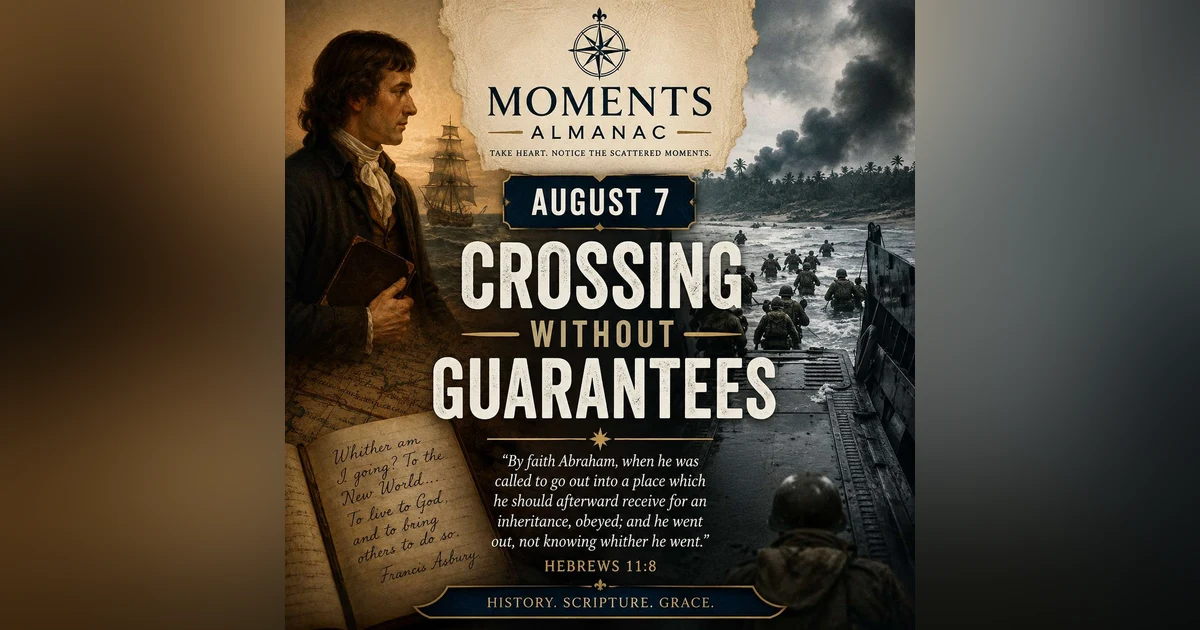


August 7, 1771: a 26-year-old lay preacher with no degree and a reputation for "rambling" past his assignment offers himself for a mission nobody could guarantee would work — and becomes the man who built American Methodism on horseback. One hundred seventy-one years later to the day, another group of Americans crosses water into territory they aren't sure they can hold: the Marines land at Guadalcanal, the first U.S. land offensive of World War II. Two crossings. No guarantees either time. Take heart. Notice the scattered moments. Share the grace.
Welcome to Moments Almanac for August 7th. And on this day in 1771, the Methodist Conference opened at Bristol, England, and John Wesley stood before his preachers with a plea. Our brethren in America call aloud for help. Wesley needed men willing to cross an ocean for work that offered no salary and no guarantee of success. Twenty-six-year-old Francis Asbury was in the room, a lay preacher with no university degree. Only two years earlier he had been reproved by his own superiors for a tendency to ramble beyond the assigned district. He spoke his mind, then he offered himself. Before that morning Asbury had wrestled with the call for nearly six months, later writing that he was unwilling to do his own will or to run before I was sent. Eight days into the Atlantic crossing, he put his deepest thoughts on paper. Whither I am going to the New World. What to do? To gain honor? No. To get money? No. I am going to live to God and to bring others to do so. He and fellow volunteer Richard Wright landed in Philadelphia on august twenty seventh. Neither man knew they were helping to begin what would be one of the largest Protestant movements in American history. But what they found first was discouraging. Asbury wrote that many of his brethren already there were reluctant to leave the comfort of the cities. Soon he turned his horse toward the countryside, and then he kept riding. For the next forty five years he traveled an estimated two hundred and seventy thousand miles from Maine to Georgia and West Ohio, preaching wherever people would gather to hear. He would later take a title of bishop, a decision Wesley never forgave. History has never entirely smoothed over that disagreement. Asbury was a builder more than a theologian, and he knew it. But the circuits he rode became the skeleton of American Methodism. He carried men willing to go where comfortable preachers would not. One hundred and seventy one years later, to the day, another group of Americans crossed the water into territory no one was certain they could hold. On this day, august seventh, nineteen forty two, the first Marine Division landed on Guadalcanal and neighboring islands in the Solomons, the first major American offensive of the Second World War. It was, as one historian described it, an operation begun on shaky legs, undersupplied, hastily planned, and launched because the alternative was allowing Japan to complete an airfield that threatened the sea lanes to Australia. The landing itself came almost unopposed. Bad weather grounded Japanese reconnaissance planes, and more than eleven thousand Marines were ashore before the defenders even realized they had arrived. But what followed was anything but easy. For nearly four months the outcome remained in doubt. The campaign became a brutal struggle of jungle fighting, disease, exhaustion, and devastating naval losses before Japan finally abandoned the island the following February. Two crossings a century and a half apart share the same unglamorous shape. Someone hears a call that offers no guarantee, says yes anyway, and discovers only afterward what it will actually cost. Asbury's yes cost him a settled life, and eventually his friendship with the man who had sent him. The Marines yes cost thousands of lives across a campaign no one expected to last so long. Neither story ends with a tidy bow. Asbury's spirit with Wesley remained a genuine wound and Guatemanal was a grinding, costly campaign long before it became a symbol of the turning tide. That's closer to how most faithfulness actually works than the version we tell in hindsight where the ending is already known and the fear gets edited out. The writer of Hebrews reminds us of another traveler who stepped into the unknown. By faith, Abraham, when he was called to go out into a place which he should afterwards receive for an inheritance, obeyed and he went out, not knowing whether he went. Abraham left without a map. Francis Hasbury boarded a ship without knowing what awaited him in the New World. Young Marines stepped onto an unfamiliar shore without knowing whether they would ever see home again. None of them knew the ending. They simply knew enough to take the next step. That's all God usually gives any of us. Faith is rarely the certainty of seeing the whole road. More often it is courage to trust the one who already has. And that's Moments Almanac for August the 7th. And I hope you'll join me tomorrow. Until then, take heart. Notice the scattered moments, and share the grace.


