August 4 | Moments Almanac | Tyger
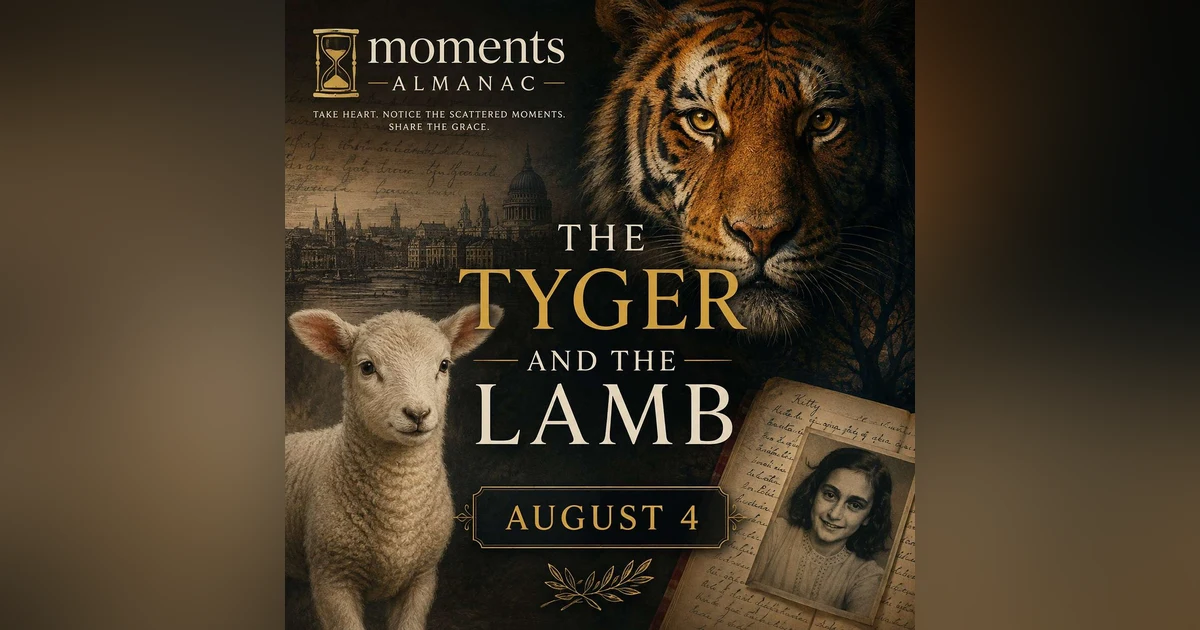
The Tyger and the Lamb | August 4 | Moments Almanac On August 4, a young apprentice named William Blake began learning the craft that would one day produce two of the most enduring poems in the English language: The Lamb and The Tyger. More than 170 years later, on that same date, Anne Frank's hiding place was discovered in Amsterdam, forcing the world to confront the very question Blake's poetry had raised. How can the God who made the Lamb also permit the Tyger? In this reflective episode o...


The Tyger and the Lamb | August 4 | Moments Almanac
On August 4, a young apprentice named William Blake began learning the craft that would one day produce two of the most enduring poems in the English language: The Lamb and The Tyger. More than 170 years later, on that same date, Anne Frank's hiding place was discovered in Amsterdam, forcing the world to confront the very question Blake's poetry had raised.
How can the God who made the Lamb also permit the Tyger?
In this reflective episode of Moments Almanac, we journey from an eighteenth-century engraver's workshop to a hidden annex during World War II, and finally to the timeless cry of Psalm 10. History, poetry, and Scripture come together to remind us that while evil is real, it never has the final word.
The Tyger still prowls.
But the Lamb still reigns.
Take heart. Notice the scattered moments. Share the grace.
Welcome to Moments Almanac for August 4th. And on this day in 1772, in London, a 14-year-old boy signed his name to an apprenticeship bond. His name was William Blake. For 50 guineas, his father bound him to an engraver, James Bazier, for seven years. Blake would spend his adolescence bent over copper plates, learning the slow, exacting discipline of cutting lines into metal. It wasn't glamorous work. It was repetition, patience, discipline, formation. The boy who learned to cut lines into copper would one day cut questions into the conscience of this world. Seventeen years later, in seventeen eighty nine, Blake published a slender volume called Songs of Innocence. Inside was a poem addressed to a lamb, little lamb who made thee. Dost thou know who made thee? The poem answers its own question. The lamb was made by the lamb of God, gentle and mild. It's a portrait of a world where innocence is cherished, where creation rests securely in the hands of its maker. Five years later, Blake published a companion volume called Songs of Experience. There another creature steps from the shadows, tiger, tiger burning bright in the forests of the night and suddenly the question changes. Did he who made the lamb make thee? Blake never answers it. He lets the lamb and the tiger stand facing one another unresolved. Some questions are too large to fit inside a poem. One hundred and seventy two years to the day after the London apprenticeship began, on that same date in August, history's tiger found a lamb. In an annex above an Amsterdam warehouse, a Jewish teenager named Anne Frank had spent more than two years hiding with her family. There she filled the pages of her diary she affectionately called Kitty, recording extraordinary hopes in the middle of extraordinary darkness. On august fourth, nineteen forty four, acting on a tip whose sources historians still debate, the Gestapo climbed the stairs to the hidden rooms. They found Anne, her family, and four others. Within weeks she was on a train bound for the concentration camps. She died of typhus in Bergen Belsen the following spring, only weeks before liberation. She was fifteen years old. Blake imagined the question. Anne Frank inhabited it. Long before Blake ever picked up an engraver's tool, before Anne Frank ever picked up a pen, the psalmist had already cried out the same anguished words Why, O Lord, do you stand far away? Why do you hide yourself in times of trouble? It's in that cry of every heart that has watched innocence swallowed by cruelty and wondered where God had gone. Scripture does not silence that question. It gives it a voice. Psalm ten lingers in the tension before quietly turning toward hope. You have been the helper of the fatherless. The Lord is king forever and ever. He will do justice to the fatherless and the oppressed. Blake left the lamb and the tiger staring at one another. Scripture leaves the tension too. But it does not leave it without hope. The worst day in a hidden Amsterdam annex, and the hardest question a poet ever asked. Grace doesn't pretend the tiger never existed. It outlasts it. Because the land still reigns. And that's Moments Almanac for today, August 4th. I hope you'll join me tomorrow. Until then, take heart. Notice the scattered moments and share the grace.


