August 31 | Moments Almanac | Pilgrim
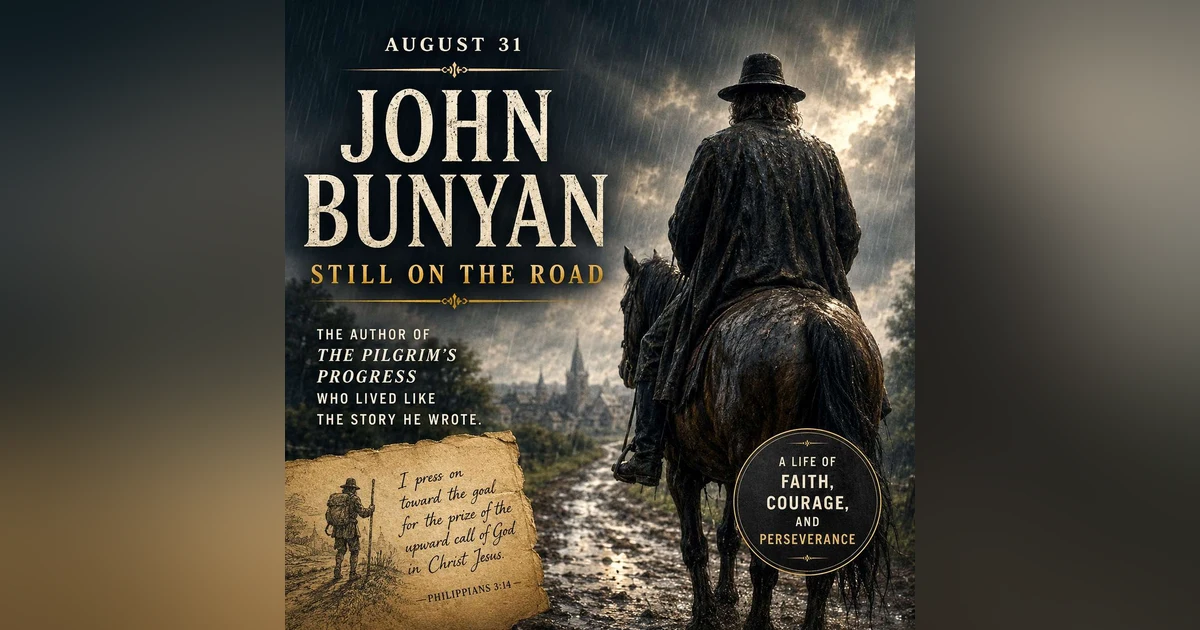


On August 31, 1688, John Bunyan died after one final journey of service. The beloved preacher and author of The Pilgrim’s Progress had traveled through heavy rain to help reconcile an estranged father and son. He returned soaked, developed a fever, and never recovered.
In this episode of Moments Almanac, we follow Bunyan from a poor tradesman’s home to a prison cell, from an unexpected conversation with a few faithful women to the creation of one of Christianity’s most enduring books.
Bunyan wrote about a pilgrim who kept walking through burdens, discouragement, doubt, and danger toward the Celestial City. Fittingly, Bunyan spent his own life doing much the same.
Sometimes faith gets its boots muddy.
You don’t have to see the Celestial City yet. You just have to keep walking.
Welcome to Moments Almanac for August 31st. This is a time for us to remember the people, places, and events that leave fingerprints on the soul. A 59-year-old preacher is riding through a driving rainstorm at England. He doesn't have to be there. He's made the journey for one reason. Father and son have stopped speaking to each other, and John Bunyan believes he might be able to help bring about the reconciliation. By the time the journey is over, he's stoked to the bone. He'll never fully recover. Within days, a fever will take his life. But by then, Bunyan has already given the world one of Christianity's most enduring books, the story of a man named Christian, who leaves everything familiar behind and begins a long journey toward the celestial city. And there's something almost poetic about the way Bunyan's own journey ends. On this day in 1688, the man who taught generations of Christians to think of faith as a pilgrimage died much the way he lived, serving someone else, following Christ and still on the road. John Bunyan was born in 1628 in a little village near Bedford, England. His father was a tradesman who repaired pots and pans and other household metalware, and young John eventually learned the family trade. By his own latter account, Bunyan wasn't particularly interested in becoming a religious hero. He described himself as a foul mouth and reckless young man, much more interested in having a good time than thinking about eternity. At sixteen he entered the army during the English Civil War. A few years later, he returned home and married. The young couple was desperately poor. Bunyan later wrote that they possessed not so much as a dish or a spoon between them. His wife brought very little into the marriage except two religious books, and Bunyan began reading them. At first not much happened. Then one ordinary day in Bedford, Bunyan passed three or four poor women sitting together in the sunshine talking about God. He stopped to listen. Bunyan thought he knew religion. He considered himself quite capable of talking about it, but these women weren't discussing religion as an idea. They talked about a new birth. They talked about temptation and grace. They talked about the work of God in their own hearts. And Bunyan realized they possessed something he didn't. And that little conversation followed him home. Eventually Bunyan joined the Bedford congregation and began preaching himself, and he was good at it. The only problem was after the English monarchy was restored in 1660, Bunyan didn't have the government's permission to preach, so they arrested him. The authorities offered him a remarkably simple arrangement. Stop preaching and go home. Bunyan chose prison for twelve years. He left behind a wife and four children, including his beloved daughter Mary, who was blind. The separation from his family nearly broke him, but prison didn't silence him. Bunyan wrote. He wrote Grace Abounding to the Chief of Sinners, the story of his own spiritual struggle, and during those prison years he began imagining another story. A man named Christian lives in a place called the city of destruction. He carries a terrible burden on his back and a book in his hand. Then he discovers he must leave. So Christian begins walking through the sloth of Despond, past Vanity Fair, through Dowding Castle, across the river toward Celestial City. The Pilgrim's Progress was published in 1678 and became a sensation. Before Bunyan died, tens of thousands of copies had circulated, and the book had already crossed the Atlantic. Bunyan eventually returned to his congregation in Bedford. He preached, he pastored, he traveled, and he wrote nearly sixty books. And then came august thirty first, sixteen eighty eight. Bunyan learned about a quarrel between a father and son. Nobody ordered him to get involved. Nobody was paying him, but Bunyan was a pastor, so he went. He travelled through heavy rain to help reconcile them, and then continued toward London, soaked and exhausted. He developed fever, and on the thirty first, John Bunyan died at the home of his friend John Strudwick. He was fifty nine years old, and there's something wonderfully fitting about the ending. The man who gave us literature's most famous pilgrim died while traveling home from helping two people find their way back to each other. Bunyan understood something about the Christian life that comfort can make us forget. Faith is not merely something we believe while sitting safely at home. Sometimes faith is getting its boots muddy. Sometimes it's getting rained on, sometimes it walks through the sloth of the spawn, passes through Dowding Castle, and keeps going when turning around would be a whole lot easier. But like Paul, these words fit his journey. I press toward the goal for the prize of the upward call of God in Christ Jesus. John Bunyan spent his life pressing on. From a tradesman's workshop through a prison cell across the pages of a book and finally down one last rain-soaked road. And maybe that's the word for us today. You don't have to see the celestial city yet. You don't have to know how many miles remain. You just have to keep walking. And that's today's Moments Almanac. I hope you'll join me tomorrow. Until then, take heart. Notice the scattered moments, and share the grace.


