August 3 | Moments Almanac | Destination
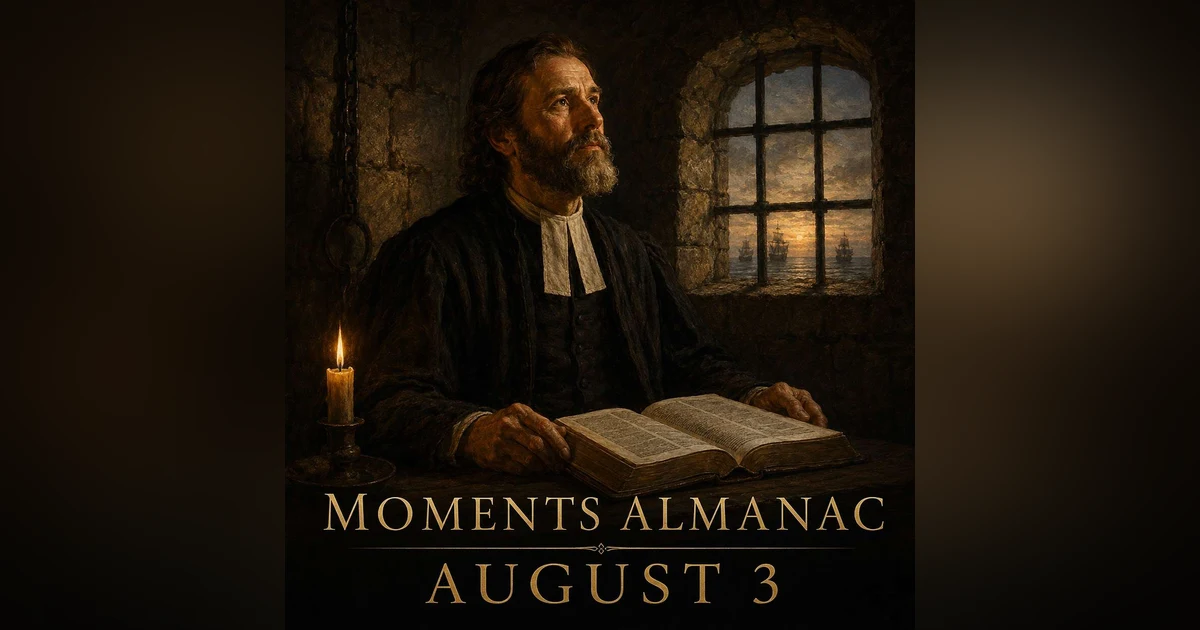


On August 3, two men stepped into uncertain futures for very different reasons. Christopher Columbus sailed west across the Atlantic on a voyage marked by extraordinary daring—and by consequences that brought conquest and suffering to Indigenous peoples. Nearly two centuries later, Baptist minister George Fownes stood before a persecuted congregation and declared, “Let the Devil do his worst.”
This episode considers the difference between courage and faithfulness, reminding us that conviction alone does not make a cause righteous. True faith is not certainty about the road ahead; it is confidence in the One who calls us forward.
As a special bonus, the episode concludes with “Worth It All,” an original song inspired by the courage and perseverance of George Fownes. Lyrics by Matt Tullos, with music and performance created through Suno. The song is also available separately as a bonus episode.
Welcome to Moments Dominac on Scattered Moments. My name is Matt Tollis, and today is August the third. Two men, three centuries and an ocean apart, each said yes to a future he could not see the end of. In the summer of 1680, George Founds stood before his congregation in Bristol, England, and told him plainly what he expected the government to do to him. Founds was a Cambridge trained scholar who had come to be the pastor of Broadmead Baptist Church, a congregation that had already buried one pastor worn down by imprisonment, and watched the next one jailed again and again, simply for preaching without a license. Officers were closing in that summer. Informers were being paid to discover their meetings. On this day, August the third, back in 1680, Founds laid out the plan to keep worshipping without any interruption. And if the magistrate himself resorted to violence, then in his own words, he said, Let the devil do his worst. He was arrested that December anyway, released on a technicality, arrested again the following spring, and then arrested again after that, cycling through Newgate and Gloucester jails for the next five years. At one trial, he served as his own attorney and was acquitted by the jury, only to be sent back to his cell regardless of the verdict. On November 29, 1685, after nearly three uninterrupted years in that final cell, George Fownes died in Gloucester jail. The church's own record remembered him as a bold and patient sufferer for the Lord Jesus Christ and the gospel he preached. He had walked into that August morning fully aware of what continuing to preach might cost him, and he walked forward anyway. And now to another familiar story. One hundred and eighty-eight years earlier, on that same calendar date, August 3rd, another man had also stepped into uncertainty, but for a very different purpose. On August 3rd, 1492, Christopher Columbus sailed the ocean blue. He set sail at daybreak from the Spanish port of Poland with three ships, roughly ninety men, and a course westward across the Atlantic. The Nina, the Pinta, and the Santa Maria carried men who believed they were sailing toward Asia. Although no European crew had successfully reached it by traveling west, Columbus did not set out to prove that the Earth was round. Educated people already knew that. Instead, he had drastically underestimated the distance between Europe and Asia. Had the Americas not stood between them, his ships well, they certainly could not have completed the journey he imagined. So with that context in mind, this journey was not a leap into the ocean thought to be endless. But it was still an enormous and dangerous gamble. Small wooden ships, limited provisions, uncertain winds, and weeks without sight of land. Columbus did not turn back. Ten weeks after leaving Spain, land came into view. But we should tell the rest of the story honestly. The land was not empty, it was not waiting to be discovered. Indigenous peoples had inhabited the Americas for thousands of years. Columbus' arrival began an encounter that would eventually bring conquest, enslavement, disease, and unimaginable suffering to the native people. So there's a little moral there. Courage does not make every cause righteous. Conviction tells us how firmly someone believes. It does not by itself tell us whether what he believes is good. That is an all-important difference between these two men. Columbus sailed forward with confidence in his calculations and ambitions. Scripture describes that kind of faith as the faith of Abraham. He went out not knowing where he was going. Faith is certainly not about the road. It's the confidence in the one that calls us onto it. Founds did not know whether he would preach another sermon or die during the next raid on his church. He was not promised safety, acquittal, or release. He was given a calling. And for George Found, Christ was worthy of the uncertainty, the chains, the cold cell, and ultimately the cost of his life. Most of us will never be asked to sail across an uncharted sea or preach under threat of prison. But all of us will eventually be asked to take a faithful step without seeing where it ends. The question is not simply whether we possess the courage to go. The deeper question is whether we are following the one who has called us. As a musical postscript to today's story, I've written an original song in honor of George Fownes entitled Worth It All, with music and performance created through Suno. The song is also being released separately as a bonus episode, so you can return to it anytime. You'll find it on Scattered Moments Podcast feed as well as scattered moments.org and now worth it all.
SPEAKER_01If they jail me and revile me, let the devil do his worst. If they shame me, cast me asunder. Let them think that I am not a good idea.


