August 1 | Moments Almanac | Whale
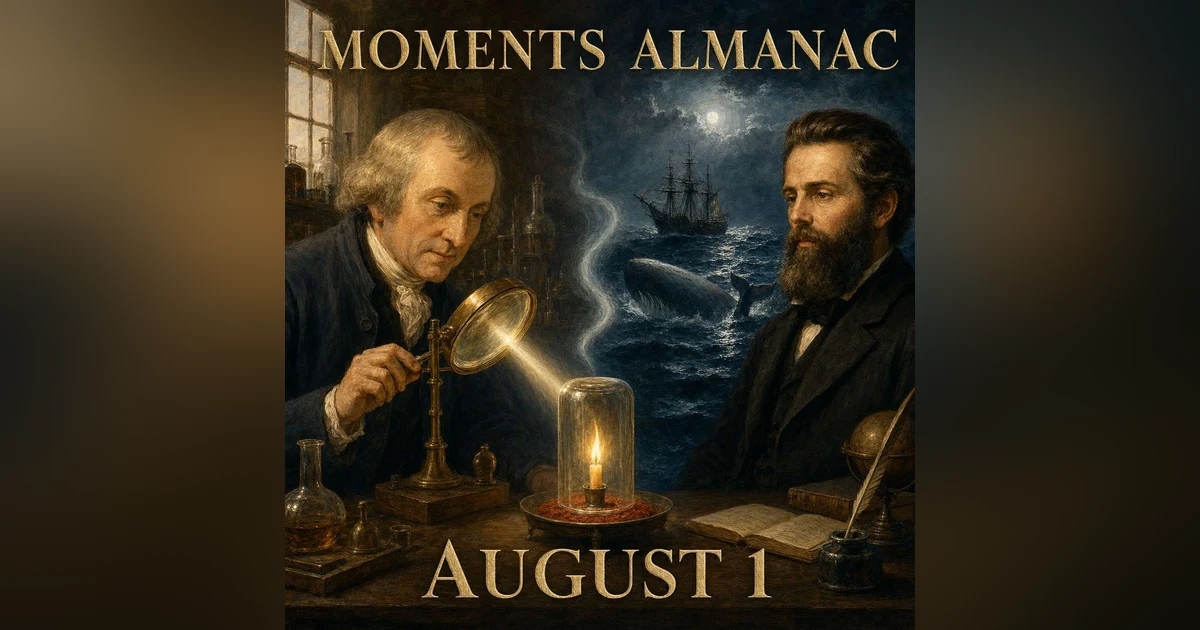


On August 1, Joseph Priestley isolated the gas we now call oxygen. Forty-five years later, Herman Melville was born—and would eventually fill Moby-Dick with images of breathlessness, surrender, judgment, and grace.
From Adam’s first breath to Jonah’s prayer beneath the waves, from Father Mapple’s pulpit to Ishmael’s rescue from the sea, this episode follows one invisible gift through science, Scripture, and literature: the breath of life.
Every breath is borrowed. Every morning is mercy. So take a breath—not because you earned it, but because it was given.
Welcome to Moments Almanac on this first day of August. And on August 1st, 1774, a British scientist named Joseph Priestley focused sunlight through a large burning lens and onto a strange red powder trapped beneath an inverted glass vessel. The powder was macuric oxide, and as it heated, it released a gas unlike any Priestley had ever encountered. When he placed a candle in it, the flame burned brighter than it had any right to. Priestley had isolated the element that had sustained every human breath since Eden. He called it deaf logisticated air. We call it oxygen. And boy am I glad. Priestley had not created life's most basic gift. He had simply caught up to something Genesis had declared from the beginning. The Lord God formed man of the dust of the ground and breathed into his nostrils the breath of life. Breath was never something we manufactured for ourselves. It was given. And then forty-five years later, on that same first day of August, Herman Melville was born in New York City into a family that took its Dutch Reform faith seriously. He grew up beneath the shadow of a sovereign and exacting God, and spent much of his life unable either to believe in him completely or to walk away from him completely. The unresolved wrestling became the engine of his greatest book. In 1851, Melville published Moby Dick, and in the story, before the ship even leaves harbor, he stops the story long enough for a retired whaler-turned preacher named Father Mapple to climb into the pulpit shape like a bow of a ship and preach from the book of Jonah. The sermon's not a decoration or some sort of sidestepping journey or preamble. It's the key that Melville places in the reader's hand before asking us to enter the deeper mysteries of the story. The text that Melville places into the preacher's mouth is Jonah, because of course it would be. He tells the great tale of a prophet who was running from God and losing his breath. The waters compassed me about, even to the soul. The earth with her bars was about me forever. Jonah has run out of air, escape, excuses. It had to be a claustrophobic experience, and we see him praying from the one place where breath should be impossible. And God answers him there, in the darkness, in the belly of the fish. Jonah repents, but repentance does not purchase its rescue. It merely opens his hands to receive the mercy he could not earn. Father Mapple calls it true and faithful repentance. It is obedience learned the hard way, in a place with no air and no exit. Ahab, the captain who dominates the rest of Melville's novel, never learns that lesson. His real war is not with a whale. It's with a universe, and perhaps a god he cannot bend to his own will. Where Jonah finally yields, Ahab never does, and it costs him everything. Eshmael alone survives the wreck of the Pequod, clinging to Quiqueg's coffin and pulled from the sea like a man who has been handed his breath a second time. He survives with nothing to his credit but grace. It's the same grace Genesis describes at the very beginning. God didn't owe Adam breath, yet he breathed into him the breath of life anyway. Centuries later, Edwin Hatch would turn that truth into a prayer. Breathe on me, breathe on me, fill me with life anew. Every breath we draw is borrowed, every heartbeat is sustained, and every morning we awaken to another gift that we did not manufacture for ourselves. Two men, linked to the same August day, 45 years apart, spent their lives chasing the same invisible mystery from opposite directions. One with a lens, a glass vessel, and red powder, and the other with ink, a ship, and a whale. Neither invented what he found. Each simply helped the rest of us notice what has been there all along. So take a breath. Not because you've earned it, but because it was given. And that's today's moments, almanac. I hope you'll join me tomorrow. Until then, take heart. Notice the scattered moments and share the grace of the


