July 29 | Moments Almanac | Completion
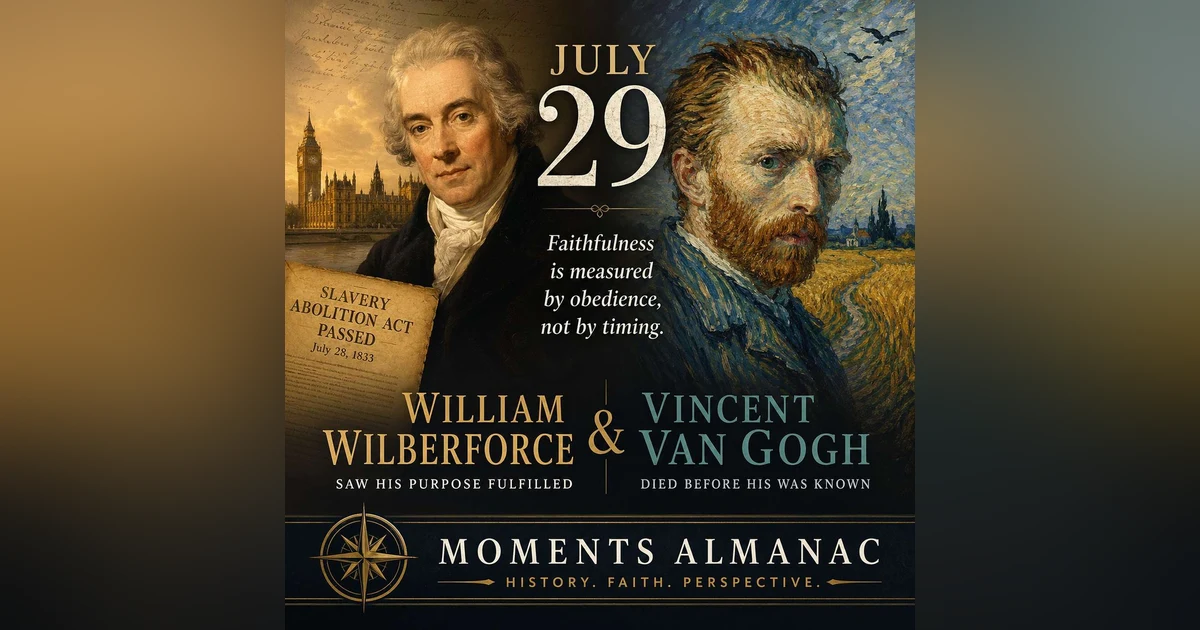

What makes a life successful? On this day in history, two remarkable men reached the end of their earthly journeys under strikingly different circumstances. William Wilberforce spent nearly fifty years fighting the British slave trade. Just days before his death on July 29, 1833, he learned that Parliament had finally passed the legislation that would abolish slavery throughout the British Empire. He died knowing the work of a lifetime had borne fruit. Fifty-seven years later, Vincent van Gog...


What makes a life successful?
On this day in history, two remarkable men reached the end of their earthly journeys under strikingly different circumstances.
William Wilberforce spent nearly fifty years fighting the British slave trade. Just days before his death on July 29, 1833, he learned that Parliament had finally passed the legislation that would abolish slavery throughout the British Empire. He died knowing the work of a lifetime had borne fruit.
Fifty-seven years later, Vincent van Gogh died believing his own life had amounted to very little. Once an aspiring minister, he left this world with almost no recognition, unaware that his paintings would forever change the way humanity sees light, color, and beauty.
Their stories raise a timeless question: Must we see the results of our faithfulness before our lives have meaning?
Drawing from Scripture, the life of Wilberforce, the tragedy of van Gogh, and the hope of Hebrews 11, this episode reflects on obedience, perseverance, and the God who sees harvests long before we do.
Sometimes God lets us see the harvest.
Sometimes He simply asks us to sow the seed.
Take heart. Notice the scattered moments. Share the grace.
Hey, thanks for joining me for Moments Almanac. Today is July 29th. And on this day in 1833, William Wilberforce lay dying in a house near Westminster, London. Three days earlier, word had reached him that Parliament had finally passed the bill to abolish slavery throughout the British Empire. He was 73 years old, and for nearly fifty years he had given his political life to that one cause. As a young member of Parliament, Wilberforce had been converted to evangelical faith, and the change nearly drove him out of public life altogether. He wanted to become a clergyman. A friend and former slave ship captain, turned pastor John Newton, urged him to remain in Parliament instead and use his seat as his pulpit. Wilberforce listened. For five decades he introduced bills, lost votes, endured ridicule, watched proposals fail, and simply kept going. His health broke down more than once along the way. And there were long stretches when abolition looked like a lost cause, even to many of its own supporters. If anyone had asked him why he persisted, the answer might have been found in the ancient words of the prophet Micah. He has shown you, O man, what is good. And what does the Lord require of you but to do justice, to love mercy, and to walk humbly with your God. Politics had become, for Wilberforce, an act of Christian obedience. He didn't live to see the law take effect. That would happen a month after his death. But he lived long enough to know it was done. He died in peace, his life's calling visibly fulfilled, and was buried in Westminster Abbey beside his friend, Prime Minister William Pitt. Fifty-seven years later, on that same calendar date, today, July 29th, a very different death occurred in a small room above an inn in Auvasois, France. Vincent Van Gogh had shot himself two days earlier in a wheat field he had painted many times. He was only 37. In just ten years, he had produced more than 2,000 works of art, yet had sold almost nothing and received almost no recognition. He had spent the previous months in an asylum in St. Remy, painting through episodes of severe mental illness that neither he nor his doctors fully understood. His brother Theo remained at his bedside through the final hours. When Theo tried to offer hope, Vincent quietly replied, The sadness will last forever. Few people realized that Van Gogh had once wanted the very thing young Wilberforce nearly chose. He had trained for ministry, preached to coal miners in Belgium, and poured himself into serving the poor. But church leaders dismissed him, believing he lacked the polish expected of a pastor. Only then did he turn to painting, uncertain whether it was even his calling. Vincent died, convinced that his life had amounted to very little. By every measure available to him that evening, it seemed he was right. But within a decade of his death, his paintings began reshaping how the world understands light, color, and beauty. Two men, one calendar date, two very different verdicts on a life. One watched the work of decades finally bear fruit. The other, Van Gogh, died before anyone could tell him that his own had. Scripture never promises that every faithful work will look like Wilbur Forces in its closing chapter. The writer of Hebrews speaks of men and women who did not receive the things promised during their earthly lives, yet were commended because of their faith. Some harvests are gathered long after the sower has gone home. As the old hymn, lead kindly light, reminds us, keep thou my feet. I do not ask to see. The distant seen, one step enough for me. That's the hidden lesson in this July day. Faithfulness is measured by obedience, not by timing. And sometimes God lets us see the harvest, and sometimes he simply asks us to sow the seeds. Either way, the field still belongs to him. And that's Moments Almanac for today, July 29th. I hope you'll join me tomorrow. Until then, take heart. Notice the scattered moments, and share the grace.


