August 8 | Moments Almanac | Wind
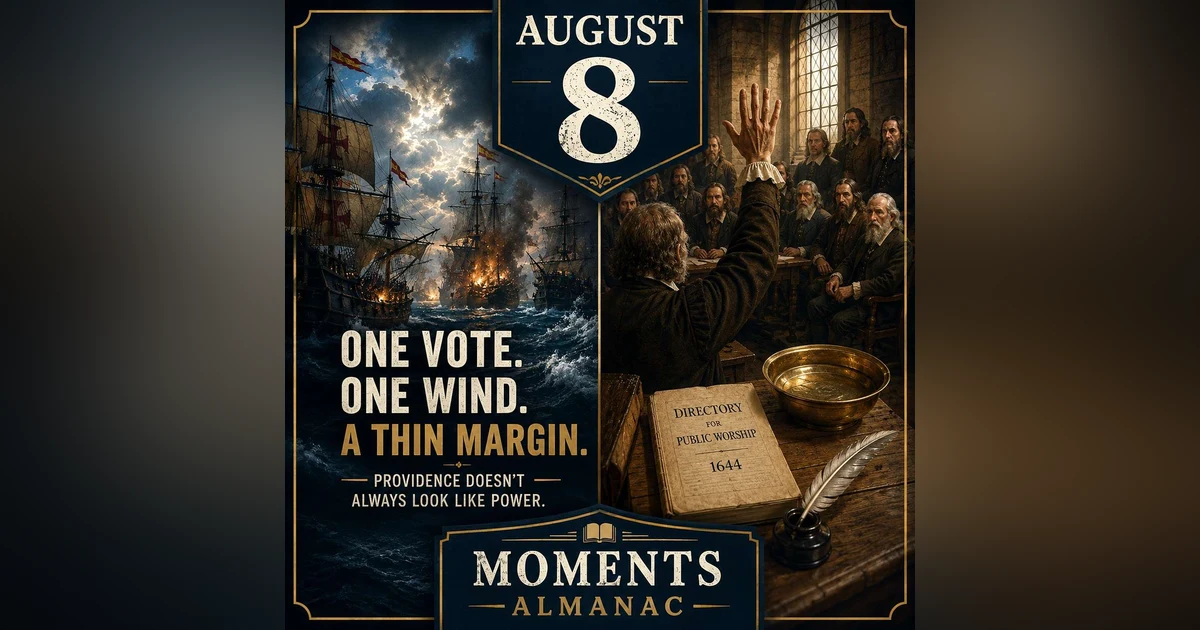


A wind shifts over the English Channel. Ministers debate baptism in a room at Westminster. Neither moment looks miraculous—but both remind us that history often turns on surprisingly small things.
In this August 8 edition of Moments Almanac, we travel from the defeat of the Spanish Armada at Gravelines in 1588 to the theological debates of the Westminster Assembly in 1644. Along the way, we consider the mystery of providence and the wisdom of Proverbs 16:33: “The lot is cast into the lap, but its every decision is from the LORD.”
We may not always understand what God is doing in history—or in our own lives. But ordinary circumstances are never beyond His reach.
Sometimes providence looks like a decision.
Sometimes it looks like a door opening.
And sometimes it looks like the wind changing direction.
Welcome to Moments Almanac, a time to remember the people, places, and events that leave fingerprints on the soul. Today is August 8th, and on this day in 1588, off the coast of Gravelines, was one of the most formidable fleets in Europe. They were just trying to survive. The Spanish Armada had sailed toward England with roughly 130 ships. Its purpose was enormous, help overthrow Protestant England and restore the country to the Roman Catholic rule. But by the time the Spanish reached gravel lines, the invasion was beginning to unravel. English fire ships had scattered the Armada's carefully arranged defensive formation. Smaller, more maneuverable English ships moved against the Spanish fleet, firing from a distance while the heavier Spanish vessels struggled to respond. For hours cannon fire rolled across the channel. The Spanish were battered. Ammunition was running low, and the wind was pushing them dangerously close to the shores along the Flemish coast. Then something happened that no admiral could command. The wind changed. The Spanish suddenly had enough room to escape northward. The Armada survived grave lines, but the invasion of England was effectively over. The Spanish fleet would attempt the long journey home by sailing around Scotland and Ireland, losing ships and men along the way. In Protestant England, people looked at what happened and saw the providence of God. Medals were eventually struck carrying the words from Scripture. God blew with his winds and they were scattered. The phrase helped create the legend of what became known as the Protestant Wind. But history is rarely that tidy. Spain prayed too. Catholics aboard those ships believed God was with them just as passionately as Protestants in England believed God was with theirs. And Christians should be careful about looking at the winner of a battle and assuming we have deciphered the secret purposes of God. Providence is not permission to explain everything God does. It is confidence that nothing lies beyond his reach. And that brings us to another August 8th. In 1644, learned ministers gathered at Westminster. They were having discussions that would eventually produce the Westminster Confession and the Directory of Public Worship. Among the questions they debated was baptism. How should the water be applied? By immersion? By pouring? By sprinkling? These were not abstract questions to them. Words written in rooms like this would eventually travel across oceans, shape denominations, divide congregations, fill libraries, and yes, determine what happened around a whole lot of baptistries. The final directory would declare that the dipping of a person into water was not necessary, and that the baptism by pouring or sprinkling was sufficient. English Baptists, of course, were moving in another direction. That same year, seven Baptist congregations in London produced a confession declaring that their convictions, including believers' baptism by immersion, was more acceptable. The debates would continue, they still do. But step back from the arguments for a moment. A room full of ministers debating water, sailors watching the wind, neither scene look particularly miraculous. And perhaps that's worth noting as well. Proverbs 1633 says, The lot is cast into the lap, but its every decision is from the Lord. The lot. It's something small, something ordinary, something that from the outside might look random. And Scripture says, Don't assume God is absent simply because you cannot see his hand. We tend to look for providence and parted seas, pillars of fire, earthquakes, angels, and thunder, and somehow, sometimes God works that way. But most of our lives are lived somewhere quieter: a conversation, a decision, a door that opens, a door that closes, a meeting, a delay, a vote, a wind that changes direction. Providence doesn't mean that we can look backward and explain every event with absolute certainty. It means that we can look upward and trust the God who sees what we cannot. Because providence doesn't always look like power. Sometimes it looks remarkably ordinary. And only later do we discover how much was riding on the wind. That's Scattered Moments for today, August 8th. I hope you'll join me tomorrow. Until then, take heart. Notice the scattered moments, and share the grace.


