June 29, 2026 | Moments Almanac | Fire
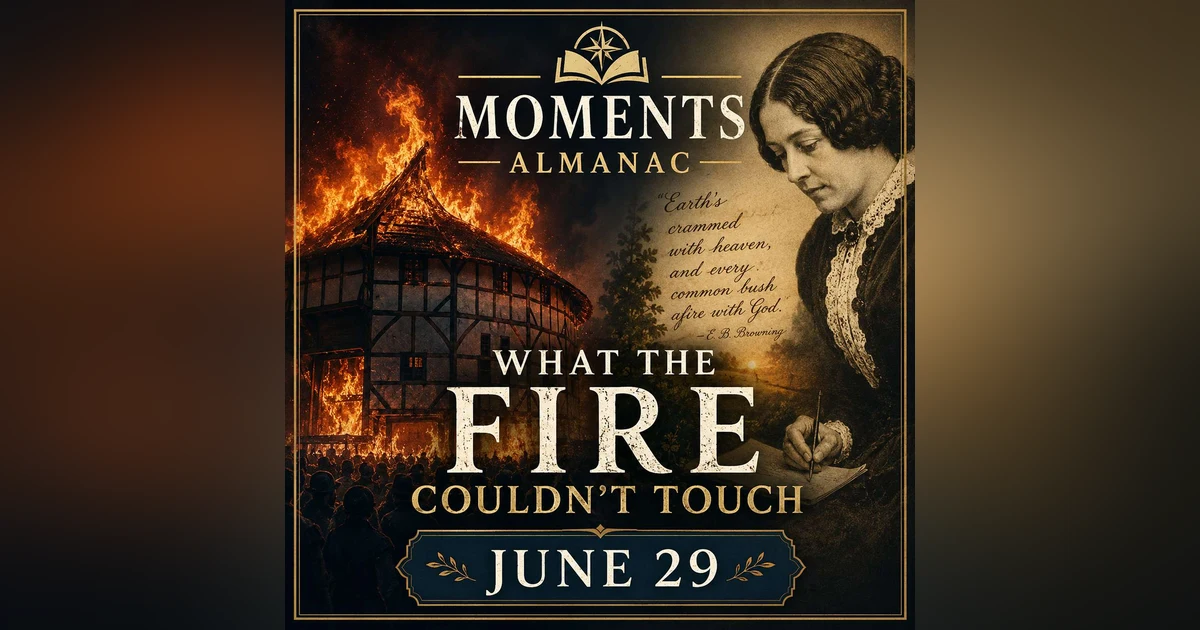
On June 29, two very different fires tell the same story. In 1613, London's Globe Theatre—the stage that gave the world Shakespeare's greatest plays—burned to the ground in less than an hour. The building was lost, but the words escaped the flames. Centuries later, we still speak many of the phrases first heard beneath its thatched roof. Two hundred forty-eight years later, Elizabeth Barrett Browning breathed her last in Florence. Her body had been weakened by decades of illness, but her visi...


On June 29, two very different fires tell the same story.
In 1613, London's Globe Theatre—the stage that gave the world Shakespeare's greatest plays—burned to the ground in less than an hour. The building was lost, but the words escaped the flames. Centuries later, we still speak many of the phrases first heard beneath its thatched roof.
Two hundred forty-eight years later, Elizabeth Barrett Browning breathed her last in Florence. Her body had been weakened by decades of illness, but her vision remained clear. In one of her most beloved poems, she reminded us that "Earth's crammed with heaven, and every common bush afire with God."
In this episode of Moments Almanac, we explore what survives when fragile vessels fail—whether a theater of timber or a body of flesh. Through Scripture, history, poetry, and hymn, we're reminded that God places eternal treasure in ordinary jars of clay.
Scripture: 2 Corinthians 4:7
Hymn: O Worship the King by Robert Grant (1833)
Some things the fire simply cannot touch.
Welcome to Moments Almanac, a time for us to remember the people, places, and events that leave fingerprints on the soul. Today is June 29th, 2026. And today's scripture anchor is found in 2 Corinthians 4.7. But we have this treasure in jars of clay to show that the surpassing power belongs to God and not to us. June 29th, two fires, two fragile vessels, one truth that survived them both. On June 29th, 1613, in London, the Globe Theatre, a cannon fires during a performance of Henry VIII. Not a real cannon, a theatrical one. The burning wadding lands in the thatched roof, and within an hour the most famous stage in England is gone. One man's britches caught fire and he reportedly put it out with a bottle of ale. That was the extent of the casualties. The play being performed was all as true, which actually became Henry VIII. It burned, but here's what didn't the words. For fourteen years they had echoed from the stage in the mouths of kings, fools, lovers and villains, prophets and clowns. By then they had already escaped the building. You've spoken them yourself. Shakespeare wrote these phrases break the ice, heart of gold, one fell swoop, love is blind, the world's your oyster, wear my heart upon my sleeve. The globe burned in an hour, the words never did. In fact, by the following year the globe had already been rebuilt. Buildings can be raised again, but the words carry truth that never really disappear. Another june twenty ninth. This time the vessel wasn't a theater. It was a woman. June twenty ninth, eighteen sixty one in Florence, Italy, Elizabeth Barrett Browning died in her husband's arms. Robert Browning wrote that she died smiling, her face like a girl's. Her last word was simply beautiful. She had lived with pain most of her life, a spinal injury as a teenager, chronic lung disease, years dependent upon morphine, and still she wrote. She taught herself Hebrew so she could read the Old Testament in its own language. She spoke against slavery. She defended children forced into factories, her body grew weaker, her vision never did. In her great poem Aurora Lee, she wrote, Earth's crammed with heaven, and every bush afire with God. But only he who sees takes off his shoes. The rest sit around and pluck blackberries. Yes, she was thinking of Moses, of the bush that burned without being consumed, but she believed that wasn't merely one miracle in the desert. She believed the whole world blazed with the presence of God. The question wasn't whether God was there, the question was whether we had eyes to see him. Her body failed. Her vision did not. Two moments, one date. A theater burns, a body gives out, and what remains? Words, the vision, the truth that could not be unsaid. The Christian faith has always believed this. What is true and beautiful does not depend upon the survival of the vessel that carried it. Paul wrote that we are jars of clay, easily cracked, easily broken, but the treasure was never the jar. It was always what God placed in it. Today, remember what has been trusted to you, the gospel you carry, the kindness you've shown, the truth you've spoken, the faith you've quietly lived. Buildings may fall, bodies will one day fail. But what God plants within his people has a way of outliving both. As the old hymn reminds us, frail children of dust and feeble is frail, in thee do we trust nor find thee to fail. Thy mercies, how tender, how firm to the end, our maker, defender, redeemer, and friend. The vessel may be fragile, the treasure is not. The fire cannot touch what God has made eternal. That's today's scattered moments. I hope you'll be back tomorrow. Until then, take care. Notice the scattered moments in your own life and share the grace.


