June 27, 2026 | Moments Almanac | Speak
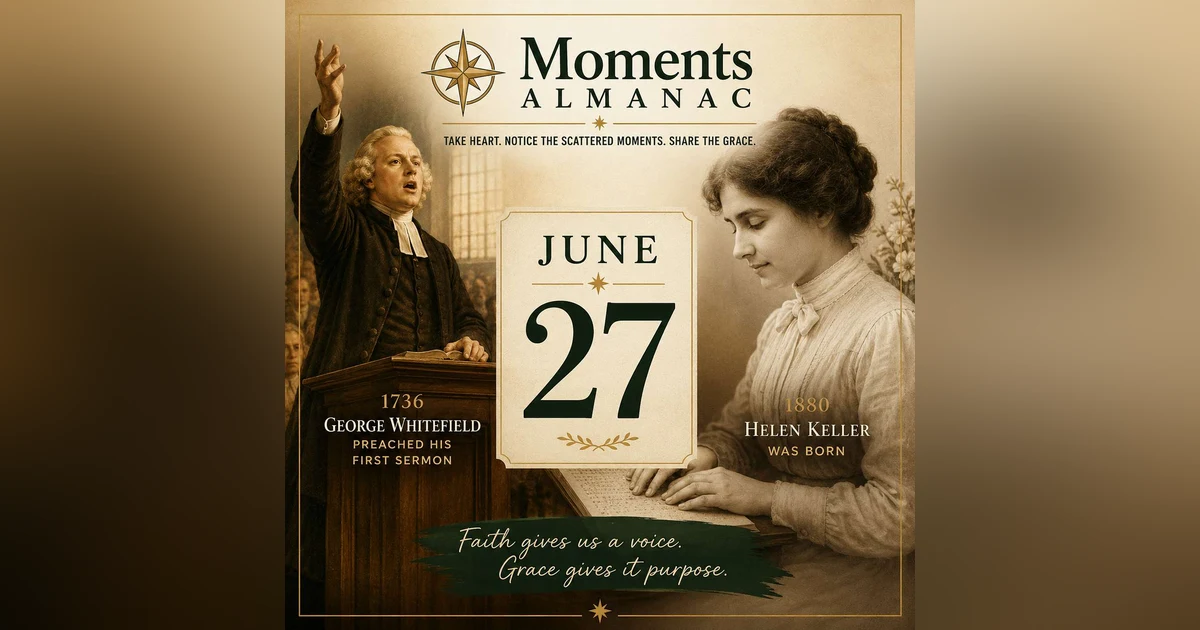
On June 27, two remarkable lives remind us that God delights in giving people a voice. In 1736, a young George Whitefield stepped into the pulpit to preach his very first sermon. He began awkwardly, surrounded by family and friends, but before long the Holy Spirit filled him with boldness. That hesitant beginning would grow into one of the most influential preaching ministries of the Great Awakening. More than a century later, Helen Keller was born in Tuscumbia, Alabama. Deaf and blind from e...


On June 27, two remarkable lives remind us that God delights in giving people a voice.
In 1736, a young George Whitefield stepped into the pulpit to preach his very first sermon. He began awkwardly, surrounded by family and friends, but before long the Holy Spirit filled him with boldness. That hesitant beginning would grow into one of the most influential preaching ministries of the Great Awakening.
More than a century later, Helen Keller was born in Tuscumbia, Alabama. Deaf and blind from early childhood, she lived in a world without words until one unforgettable moment unlocked the gift of language. She would go on to become one of the world's most recognized authors, advocates, and speakers.
Their stories ask a simple question: How is God calling you to use your voice today?
Today's Scripture: Psalm 51:15
"Open my lips, Lord, and my mouth will declare your praise."
Take heart. Notice the scattered moments. Share the grace.
Well, hello and welcome to June 27th, 2026 and Moments Almanac. Our anchor scripture today is Psalm 51, 15. Open my lips, Lord, and my mouth will declare your praise. Some voices shake nations and others change one life at a time. On June 27, 1736, a 21-year-old Oxford student named George Whitfield preached his very first sermon. He was nervous. His mother was there, his brothers and sisters were there. People had watched him grow up, and now they filled the room. He later admitted he stumbled through the opening. Then something changed. The spirit filled me, he wrote. More than a century later, on this same day in eighteen eighty, Helen Keller was born in Tuscumbia, Alabama. Nineteen months later, illness stole both her sight and her hearing. One young preacher found his voice, and one little girl would spend years searching for hers. George Whitfield never expected to become one of history's greatest evangelists. He was the son of an innkeeper, a commoner, poor, small in stature. At Oxford he joined a little gathering called the Holy Club with John and Charles Wesley. They prayed, studied scripture, visited prisoners, served the poor. When Whitfield preached that first sermon, the words seemed almost too much for the congregation. They said people had become emotional. Whitfield wasn't embarrassed. He simply wrote Glory, glory, glory, be ascribed to the Almighty Triune God. That first sermon became thousands. He crossed the Atlantic thirteen times, preached in fields because churches were too small. Sometimes he spoke to crowds estimated in the tens of thousands without a microphone. Benjamin Franklin once paced off the distance of one of Whitfield's outdoor sermons and calculated that his voice could be heard by nearly thirty thousand people. Helen Keller's beginning looked altogether different. Darkness, silence, frustration. She later described herself as living in a world without words. Then Anne Sullivan arrived. One spring day she placed cool water over Helen's hand and spelled WATER into the other. Suddenly the connection came. Everything had a name. Language flooded in. Helen would later master Braille, graduate from college, write some books, lecture around the world, and become one of the 20th century's strongest advocates for people living with disabilities. The child who could neither hear nor speak became one of the world's most recognizable voices. It's easy to believe that God only uses people who already know what to say. Whitfield didn't. His first sermon began awkwardly. Helen Keller couldn't speak clearly for years, yet both remind us that God delights in opening mouths. Perhaps your voice isn't a sermon. Perhaps it's a conversation over coffee. Maybe it's a bedtime prayer with your child. Or maybe it's an apology that you've been avoiding, or a word of encouragement that someone desperately needs today. You don't have to sound like George Whitfield. You don't have to overcome what Helen Keller overcame. You simply have to offer God the voice you've been given because sometimes one sentence, one spoken in faith, changes a life forever. That's today's Moments Almanac. I hope you'll join me tomorrow. Until then, take care. Notice the scattered moments and share the grace.


