June 26, 2026 | Moments Almanac | Wall
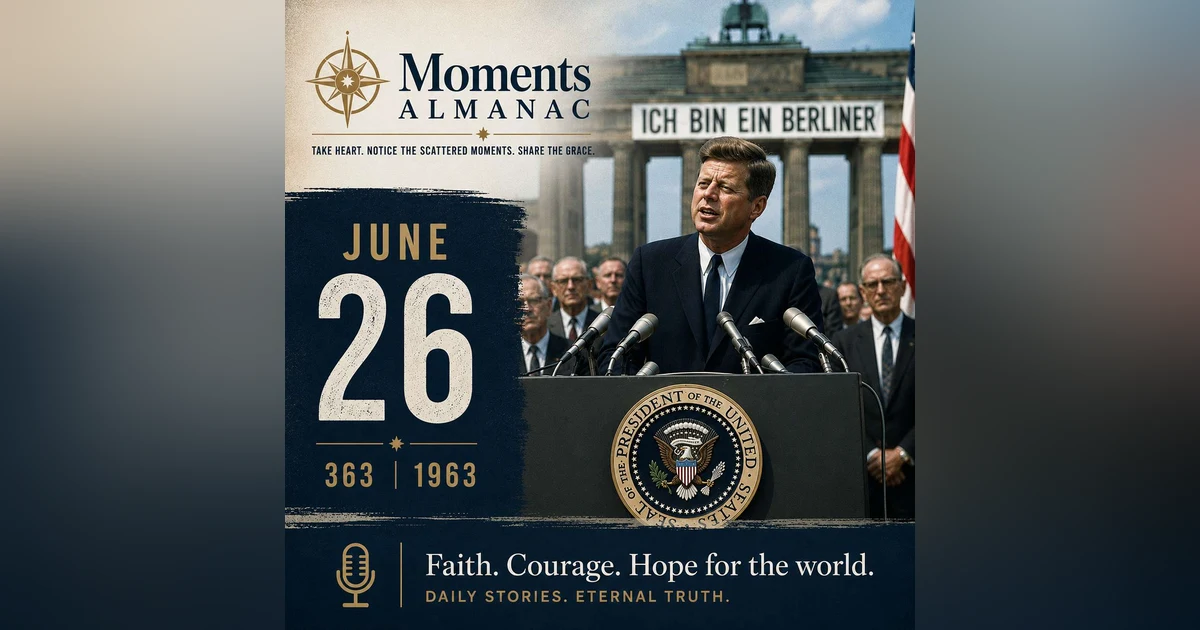


On June 26, two men stood under extraordinary pressure and uttered words that history has never forgotten.
In 363, the Roman Emperor Julian—remembered as "Julian the Apostate"—died after spending two years trying to reverse the rise of Christianity. Tradition says his final words were, "Thou hast conquered, O Galilean."
Sixteen centuries later, in 1963, President John F. Kennedy stood before a divided Berlin and declared, "Ich bin ein Berliner"—"I am a Berliner"—offering hope to a city surrounded by walls.
What do those two statements have in common?
Both reveal that what we claim as our citizenship shapes how we live, what we defend, and what we confess when life presses hardest.
Today's Scripture: Revelation 22:20 and Philippians 3:20
Take heart. Notice the scattered moments. Share the grace.
Welcome to Moment Salmanac. A time to remember the people, places, and events that leave fingerprints on the soul. You made it to Friday. It's June 26, 2026. And our scripture today is one that I find myself repeating often these days. He who testifies to these things says, Surely I am coming soon. Amen. Come, Lord Jesus. Revelations 22, 20. Two significant things on this day. On June 26, the year was 363. The Roman Emperor Julian died from a battle wound in a Persian desert. He had spent two years trying to roll Christianity back, closing churches, stripping funding, mocking the faith, restoring the old gods. He called Christians Galileans, a slur meant to shrink them back to a backwater sect. When the spear found him, the story goes that he looked up and said, Ninecachus Galilee, thou hast conquered, O Galilean. 1600 years later, on the same date in 1963, John F. Kennedy stood before 120,000 people in West Berlin, a city divided by a wall of concrete and ideology, and said four words in German. In the world of freedom, the problem is the Lima. Both men spoke under pressure, one dying, one defiant. Both said something about where they stood. Julian was Constantine's emperor, raised in the imperial household, baptized Christian, educated in the faith, but instead he found more solace in Plato than in Paul. When he became an emperor in 361, he didn't hide it anymore. He was sharp, serious, morally earnest, and he hated what the church had become. He wrote a lengthy polemic called Against the Galileans. In it he couldn't deny that Jesus healed the blind, calmed the sea, and cast out demons. He just tried to explain it away. He aimed to overthrow Christianity. He ended up confirming it. His death ended the last formal imperial opposition to the faith. Within seventeen years, Christianity would become the official religion of the Empire. Kennedy's Berlin was a different kind of contest. The wall had gone up just two years before. Families were separated overnight. People were shot trying to cross. The Western Allies had done nothing to stop it. There was nothing that they could do short of starting a third world war. West Berlin felt abandoned. Kennedy arrived, looked over the wall at Checkpoint Charlie in silence. He got back in the car and started rewriting his speech on note cards. He stood before that crowd and said, Freedom is indivisible. And when one man is enslaved, all are not free. And then in German he declared himself one of them. Kennedy was borrowing an older boast. He even said so. Two thousand years ago the proudest claim was civis romanus sum. I am a citizen of Rome. Now he said the proudest claim was Ich bin I Berliner. Where you belong shapes what you're willing to say, what you're willing to stand for, what you declare under pressure. Julian knew this too. He had been given citizenship in the kingdom of Christ by baptism, he renounced it, he built his own reign around belonging somewhere else. And then at the end, with a wound in his side, the story says he looked up and named the one he could never quite shake. We don't know if the words are historical, we know they ring true though. Because you can spend a lifetime building walls against a kingdom and still die naming its king. Paul said it plainly, our citizenship is in heaven. From it we await a Savior, the Lord Jesus Christ. Philippians 3 20. That's not retreat from the world, it's a declaration made in the world, under pressure, in public, when it costs something. Kennedy stood at a wall and said, I belong to these people. Julian lay dying, and legend says named the one he belonged to all along. So the question we must ask is, what wall are we standing on today? What name do we say under pressure? Lord Jesus, the one who conquered, not with armies or edicts, but with an open tomb and a borrowed name that keeps us coming up even when we try to argue our way past it, remind us what city we belong to. When the walls go up around us, inside us, make us the kind of people who declare our citizenship anyway. Not because we're brave, but because we know whose we are. Come quickly, Lord Jesus. Amen. That's today's scattered moments. Until next time, take care. Notice the scattered moments and share the grace.


