June 24, 2026 | Moments Almanac | Dark
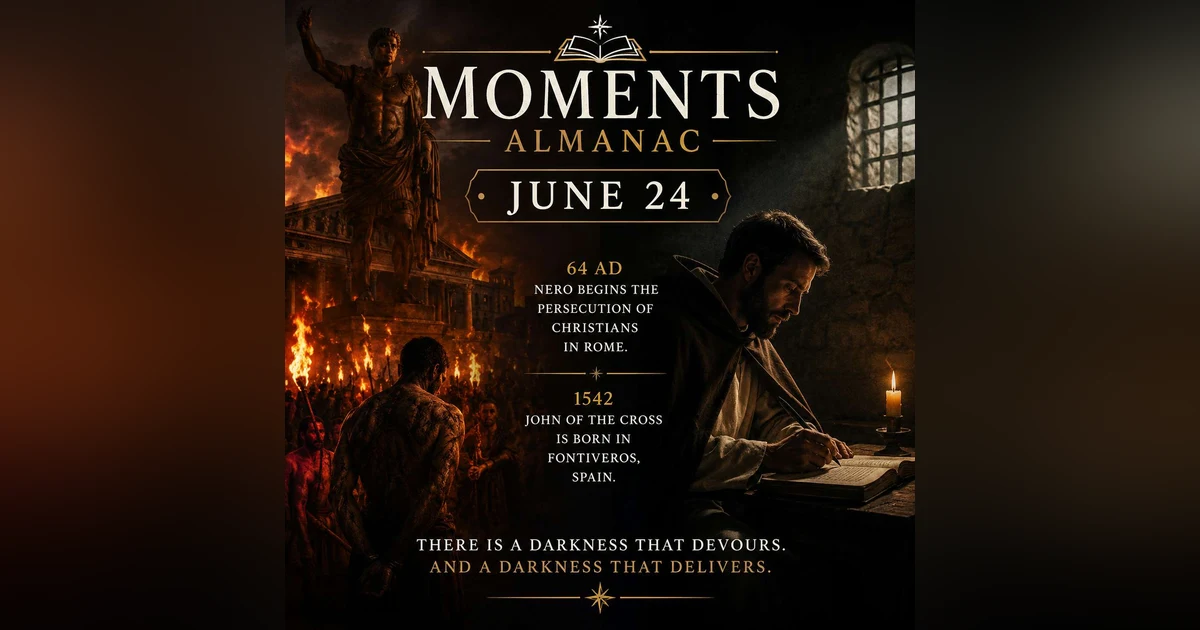


On June 24, 64 AD, Emperor Nero began the brutal persecution of Christians in Rome. Men and women were arrested, crucified, and even burned as human torches in the emperor's gardens. Nero believed fire could silence the faith.
Nearly fifteen centuries later, on the same date, John of the Cross was born in Spain. Imprisoned by his own religious order and confined to a dark cell, he discovered something remarkable: sometimes God does His deepest work in the dark. From that prison came The Dark Night of the Soul, one of the most enduring spiritual works in Christian history.
One man used darkness to destroy.
The other found God within it.
In today's episode, we explore the contrast between Nero's cruelty and John of the Cross's faith, and the enduring truth that the light shines in the darkness—and the darkness has not overcome it.
Scripture: John 1:5
"The flame shall not hurt thee; I only design
Thy dross to consume and thy gold to refine."
Take heart. Notice the scattered moments. Share the grace. ✨
Welcome to Moments Almanac, a time to remember the people, places, and events that leave fingerprints on the soul. Today is June 24th, 2026, and today gives us two men separated by nearly 15 centuries. One tried to extinguish the light, the other learned to find it in the dark. Our scripture anchor today comes from John 1.5. The light shines in the darkness, and the darkness has not overcome it. On this day in 64 AD, Emperor Nero began what became the first great persecution of Christians in Rome. Rome had burned for six days. Fire swept through the ancient city, entire neighborhoods vanished into smoke and ash. And when the flames died down, suspicion settled on Nero himself. So Nero had another target. He pointed at the Christians. The Roman historian Tacitus tells us what happened next. Christians were arrested and condemned, not so much for arson, he says, but for what the Empire considered a strange and dangerous way of life. Some were torn apart by wild animals, some were crucified. And then came the horror that history still remembers. Christians were wrapped in animal skins, covered with pitch, and set on fire to illuminate Nero's evening garden parties. As they burned, Nero mingled among the crowd, dressed as a charioteer, turning suffering into spectacle, even Tacitus, no friend of Christianity was disturbed. Public sympathy began shifting toward the Christians. The punishment seemed driven not by justice, but by the cruelty of one man. The cruelty had become Nero's native language. He had murdered his mother, poisoned his rivals, kicked his pregnant wife to death, built a lavish golden palace over the ruins of the city, and erected a colossal statue of himself more than one hundred feet high. Power had curved inward until there was room for no one else. Yet history has a way of surprising us, because on this same day, fifteen centuries later, June twenty fourth, fifteen forty-two, a child was born in a small Spanish village called Fonteneros. His name was Juan de Liepez. History remembers him as John of the Cross. He was born into hardship. His father had been disowned for marrying beneath his social class, and when his father died, John's mother struggled to keep the family alive, moving from town to town in search of work and bread. From an early age he learned what darkness felt like from the inside. As a young man he became a Carmelite friar and joined Theresa of Avila in reforming the order. They called believers to a simpler, deeper, more disciplined faith. Not everyone appreciated the effort. They called believers to a simpler, deeper, more disciplined faith. Not everyone appreciated the effort. Members of his own religious order eventually arrested him. He was imprisoned in Toledo, his cell measured only by a few feet across. Almost no light entered. For nine months he lived in isolation, and there in the darkness he began to write. He wrote poetry about the soul slipping quietly into the night to meet God. He described a journey beyond feelings, beyond certainty, beyond spiritual comfort. He called it the dark night of the soul. Not as a complaint, not as despair, as a map. John believed that God sometimes removes the comforts we depend upon, not to abandon us, but to deepen us. The darkness is not always evident in God's absence. Sometimes it is evidence of God's work. And that brings these two men together. Both encountered darkness, both used it. Nero used darkness to conceal truth, protect himself, and consume others. John used darkness to surrender, to trust, to seek God more deeply. One made darkness a weapon, the other made darkness a doorway. And here's the beautiful irony. Nero's fires did not destroy the church, they strengthened it. The courage of the martyrs created witnesses. Their peace in suffering raised questions. Their faithfulness in death became one of the great testimonies of the early church. You cannot burn down what is not afraid of fire. And John of the Cross emerged from his prison cell carrying words that still guide believers through the seasons of grief, doubt, and silence. The darkness that confined him became the lantern he carried for others. Nero built a towering statue to himself. John of the Cross built a path toward God. Nero died abandoned, fleeing Rome after the Senate declared him an enemy of the state. His palace disappeared, his statue was altered, his empire moved on without him. John died poor, misunderstood by some, and suffered physically, yet centuries later, people still read his words. One man's legacy crumbled like a stone, and the other still shines like a candle. Perhaps that's the lesson of June 24th. There is a darkness that devours, and there is a darkness that delivers. The difference is not the darkness. The difference is what or who you trust while you were in it. That's today's Moments Almanac. Until tomorrow, take care. Notice the scattered moments and share the grace.


