June 23, 2026 | Moments Almanac | Write
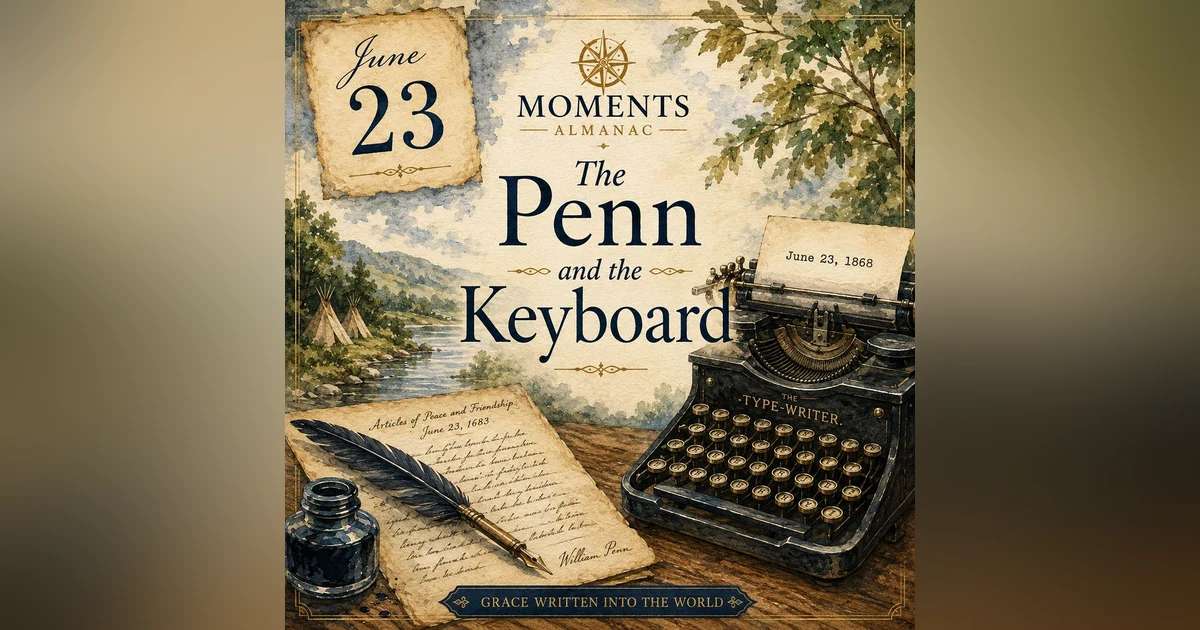


On June 23, 1683, William Penn signed a remarkable treaty with the Lenni Lenape people of Pennsylvania—a peace agreement built not on force or fear, but on mutual respect and trust. Penn believed God's law was already written on the human heart.
Nearly two centuries later, on June 23, 1868, Christopher Latham Sholes received a patent for an invention that would change the way ideas travel through the world: the typewriter.
One man used words to build peace. Another built a machine that would carry words across generations.
Together, their stories point us back to an ancient promise from Jeremiah: "I will put my law within them, and I will write it on their hearts."
Join us as we explore treaties, typewriters, Quakers, keyboards, and the grace that is often written into the world long before it is written on a page.
Scripture: Jeremiah 31:33
Hymn: "Dear Lord and Father of Mankind" by John Greenleaf Whittier
Take heart. Notice the scattered moments. Share the grace.
Hello and welcome to Moments Almanac, a time to remember the people, places, and events that leave fingerprints on the soul. Today is June 23rd, 2026. And if I were to entitle this episode, I'd probably call it the pen and the keyboard. I think by the end of the episode you'll understand why. Today's scripture comes from Jeremiah 31, 33, which says, I will put my law within them, I will write it on their hearts, I will be their God, and they shall be my people. Long before ink touches paper, before signatures mark treaties, before words fill pages, God says he writes something first upon the human heart. That promise echoes two remarkable moments on this date. On june twenty third, sixteen eighty three, William Penn signs a treaty with the Linilenape of Pennsylvania. No oaths, no soldiers, no threats, just an agreement between people who sat together under the open sky. He believed the image of God was already present in the people across from him. He believed God's laws, that they were not merely imposed from above, but written, however imperfectly upon the human heart. Voltaire, not known for praising Christians, later remarked that it was the only treaty between native peoples and colonists that was never broken. Penn's path to that moment had not been easy. Born into privilege, Oxford educated, son of an English admiral. Then one day in Ireland he wandered into a Quaker meeting and never truly left. His father disowned him, the crown imprisoned him in the Tower of London, and there in the prison cell he wrote the words that would become his most famous work. No pain, no palm, no thorns, no throne, no gall, no glory, no cross, no crown. Penn understood that faith was not an escape from the world. It was a calling deeper into it toward peace, justice, humility. The law of God written on the heart eventually finds its way into our hands and sometimes into our actions. Nearly two centuries later, on june twenty third, eighteen sixty eight, another man put something into human hands. Christopher Lathan Scholes received a patent for a machine he called the typewriter. Scholes was a newspaper editor, a tinkerer, a man who enjoyed solving problems. He began with a simple idea and ended up changing how words travel through the world. The keyboard beneath our fingers today, it still bears the marks of his invention. QERTY. One historian wrote that Scholes devoted his God-given genius not for selfish gain, but for the benefit of mankind and future generations. A pen, a typewriter, a keyboard. The tools change. The impulse remains. Human beings are always reaching across distance, trying to communicate, trying to preserve truth, trying to keep promises, trying to say what matters, because something inside us longs to be known and to know others, something already written there. That longing reminds me of a hymn that was written by another Quaker, John Greenleaf Whittier. Drop thy still dews of quietness till all our strivings cease. Take from our souls the strain and stress, and let our ordered lives confess the beauty of thy peace. Perhaps that is the thread connecting today's moments. A pen and a keyboard, a treaty signed in peace, a machine built to carry words. Today, notice what you're reaching for, what you're trying to say, who you're trying to reach. There may be more grace in that impulse than you know. Well, that's today's scattered moments. Until tomorrow, take care. Notice the scattered moments and share the grace.


