June 16, 2026 | Moments Almanac | Transformed
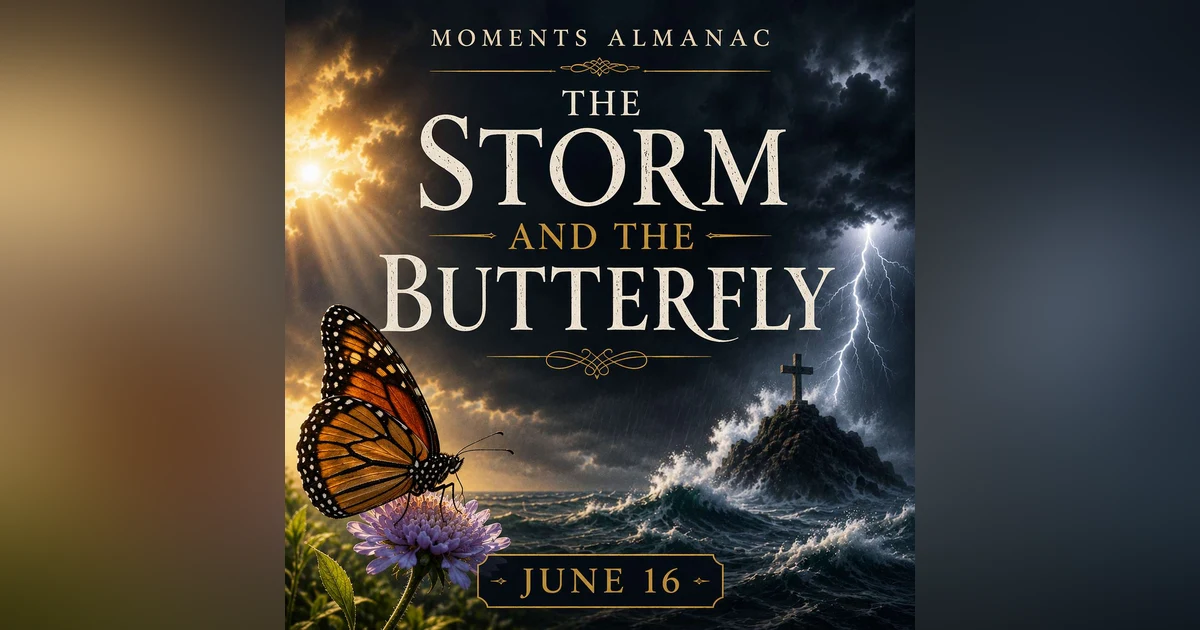
🦋 🌊 June 16 – The Storm and the Butterfly What does a butterfly have to do with the resurrection? And what can a storm-tossed ocean teach us about compassion? In this episode of Moments Almanac, we remember two remarkable stories connected to June 16. First, we meet Joseph Butler, the eighteenth-century bishop and apologist who challenged skeptics by pointing to the natural world itself. Looking at the transformation of a caterpillar into a butterfly, Butler saw evidence that God had written ...


🦋 🌊 June 16 – The Storm and the Butterfly
What does a butterfly have to do with the resurrection? And what can a storm-tossed ocean teach us about compassion?
In this episode of Moments Almanac, we remember two remarkable stories connected to June 16.
First, we meet Joseph Butler, the eighteenth-century bishop and apologist who challenged skeptics by pointing to the natural world itself. Looking at the transformation of a caterpillar into a butterfly, Butler saw evidence that God had written the pattern of resurrection into creation.
Then we journey to Victorian England, where William and Catherine Booth began a partnership that would eventually become The Salvation Army. Inspired by a vision of a drowning world, they devoted their lives to rescuing the forgotten, feeding the hungry, and sharing the hope of Christ.
From the wings of a butterfly to the waves of a stormy sea, this episode explores faith, resurrection, and the call to step into the needs of a hurting world.
"Perhaps that's the invitation for us today: to see signs of God's grace all around us—and then to carry that grace to someone who needs it."
Welcome to Moments Almanac, a time to remember the people, places, and events that leave fingerprints on the soul.
Welcome to Moments Almanac, a time to remember the people, places, and events that leave fingerprints on the soul. Today is June 16th, 2026, and a date that gives us an opportunity to remember a philosopher who defended the faith with the wings of a butterfly and a husband and wife who fell in love on a simple walk and helped change the world because of it. We begin in the year 1752. England was in the grip of a philosophical crisis. The deists were winning the arguments in the drawing rooms and universities. They believed in God, yes, but a distant God, a God who wound up the clock of creation and walked away. No resurrection, no revelation, no personal savior. Into that crisis stepped Bishop Joseph Butler, and on june sixteenth, seventeen fifty two, he drew his last breath, leaving behind what many consider the most important work of Christian apologetics of the eighteenth century, the analogy of religion. Butler's method was elegant and disarming. He didn't begin by quoting scripture at his opponents. He met them on their own ground, the natural world they claim to trust. And then he asked a simple question Have you ever watched a caterpillar become a butterfly? A living creature wraps itself in what appears to be a tomb, then impossibly it emerges transformed, glorious, beautiful, and new. Butler argued that nature itself whispers resurrection. The same God who wrote that pattern into creation, wrote it into life itself, into life, death, and rising of his son. His arguments built a cumulative case for faith, persuading skeptics not by demand, but by discovery. He influenced thinkers as diverse as John Wesley and David Hume. One followed him toward the altar, the other could never quite shake his reasoning. Joseph Butler, buried in Bristol Cathedral, a man who looked at a butterfly and saw the gospel. Now, one hundred years later, same country, different story. A young Methodist preacher named William Booth was traveling through the English countryside. His thoughts were fixed on the lost, the poor, the broken, the overlooked people beyond the walls of respectable religion. Then came a vision. He saw a dark and stormy ocean, deep clouds hung overhead, the wind moaned, the waves towered and crashed, and in that ocean were millions of people struggling, drowning, crying for help. Then he saw a great rock rising above the storm. Around its base was a vast platform where some had found safety. The rock was Christ. The platform was the church. But what troubled Booth the most was not the ocean. It was the people standing safely on the platform. Many seemed unconcerned about those still drowning, even when those drowning were their own husbands and wives and brothers and sisters and sons and daughters. That vision became his mandate. That ocean became his mission field. William Booth had experienced a dramatic conversion at 15 and had already become a preacher. But the vision of the drowning transformed this preacher into a general. And on June 16, 1855, William Booth married Catherine Mumford, the woman who would become his partner in ministry and co-architect of everything that followed. They fell in love almost immediately. William walked Catherine home after they met, and she later wrote, Before we reached my home, we both felt as if we were made for each other. Two people. One walk home, one shared calling. By 1865, Booth had established mission stations among the poor of London's East End, feeding the hungry and caring for those society had forgotten. He understood something profound. You can't warm the hearts of people with God's love if they have an empty stomach and cold feet. What began as a Christian mission became in 1878 the Salvation Army, now serving more than 130 countries around the world. Practical compassion, the proclamation of the gospel. Both held together. Two fingerprints on June 16th. Joseph Butler, who reminded us that the evidence of resurrection is written in the very fabric of creation, and William and Catherine Booth, who looked at a drowning world and decided someone had to go in after them. They did not wait for the storm to pass. They stepped in. Perhaps that's an invitation for us as well. To see God's grace all around us, and then to carry that grace to someone who needs it. That's today's scattered moment for June 16th, 2026. I hope you'll join me tomorrow. Until then, take care. Notice the scattered moments and share the grace.


