June 14, 2026 | Moments Almanac | Humanity
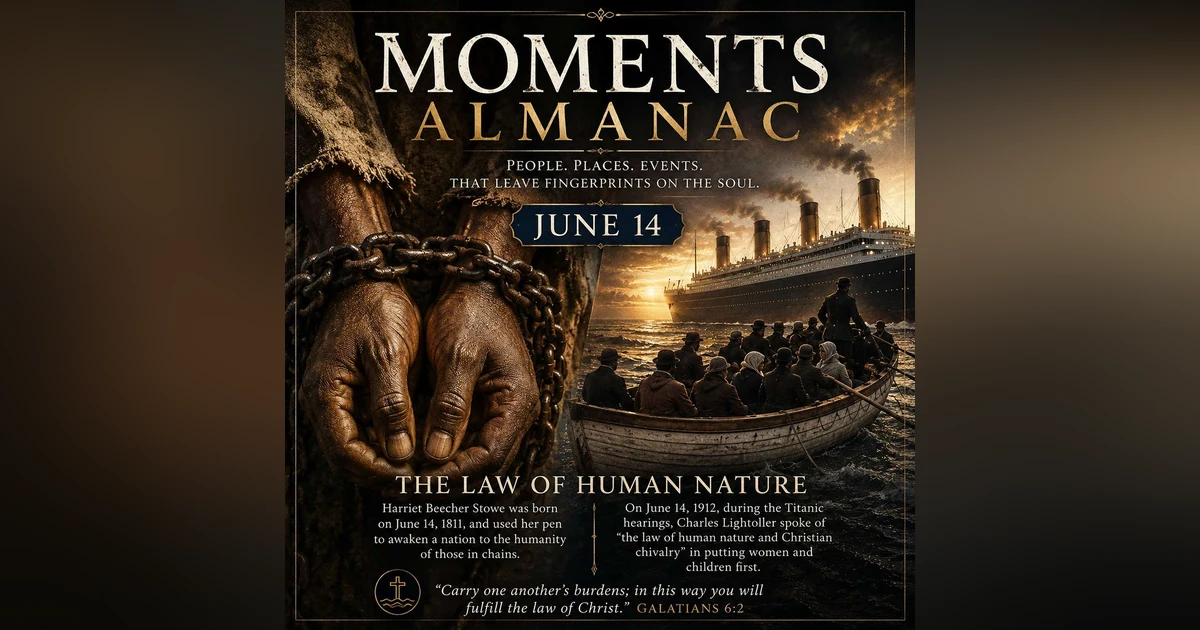


On this episode of Moments Almanac, we reflect on two stories connected by a common thread of compassion.
Born on June 14, 1811, Harriet Beecher Stowe used her pen to awaken a nation's conscience, reminding readers of the humanity of those trapped in slavery. More than a century later, during the Titanic hearings of 1912, Second Officer Charles Lightoller spoke of "the law of human nature and Christian chivalry" as he described the principle of putting women and children first in the lifeboats.
Together, these stories ask a timeless question: Will we see the needs of others above our own?
Drawing from Galatians 6:2 and the example of Christ, this episode explores the Christian call to bear one another's burdens and to recognize the sacred worth of every person.
Join us as we remember the people, places, and events that leave fingerprints on the soul.
Hello and welcome to Moments Almanac on this Sunday, June 14th, 2026. You know, some dates remind us of great victories, others remind us of great discoveries, but today invites us to remember something quieter and perhaps more important, the simple truth that every person bears the image of God and deserves our best compassion. On this day in 1811, Harriet Beecher Stowe was born. Harriet Beecher Stowe grew up in a deeply religious home and became one of the most influential writers in U.S. history. Her novel, Uncle Tom's Cabin, helped awaken many Americans to the cruelty of slavery. More than a political argument, her book was a plea for people to see enslaved men, women, and children as human beings, people with families, hopes, fears, and souls. She believed that when we truly see another person, it's hard to ignore their suffering. A century later another story of human compassion was being discussed on this date. In June of nineteen twelve, hearings continued on the sinking of the great ocean liner Titanic. During his testimony on june fourteenth, second officer Charles Leitoler spoke about the practice of women and children first. He described it as part of the law of human nature and Christian chivalry. The language may sound old fashioned to modern ears, but the principle remains powerful. When crisis comes, the vulnerable should not be forgotten. When there are not enough seats on the lifeboat, strength should make room for weakness. When fear urges us to think only of ourselves, compassion calls us to think of others. Though separated by a century and different circumstances, Harriet Beecherstow and Charles Leitoler were asking the same question. Will we recognize the value of another human life? The apostle Paul wrote in Galatians six two, carry one another's burdens. In this way you will fulfill the law of Christ. Christian compassion has never been merely a feeling. It's always been action, it's been bearing burdens that are not our own. It is speaking when silence would be easier, it is making room for another person when the world would tell us to look out for ourselves. The hymn writer expressed it this way Lord whose love through humble service bore the weight of human need, who upon the cross forsaken worked your mercy's perfect deed. Jesus Himself showed us what compassion looks like. He touched the lepers, he welcomed children, he wept with grieving sisters. He carried a cross that was not his to bear because of our burden, and that's the lesson of June fourteenth. Whether writing a novel that stirred a nation's conscience or helping passengers into lifeboats on a freezing night at sea, the greatest acts of humanity begin when we stop asking, What do I deserve? and begin asking, How can I help? On this June fourteenth, may we remember Harriet Beecher Stowe and Charles Lightholder. And may we remember that every act of kindness, every burden shared, every sacrifice we make for another person reflects the heart of Christ. This has been Scattered Moments for June 14th, 2026. I hope you'll join me tomorrow. Until then, take care. Notice the scattered moments, and share the grace.


