July 2, 2026 | Moments Almanac | Lightning
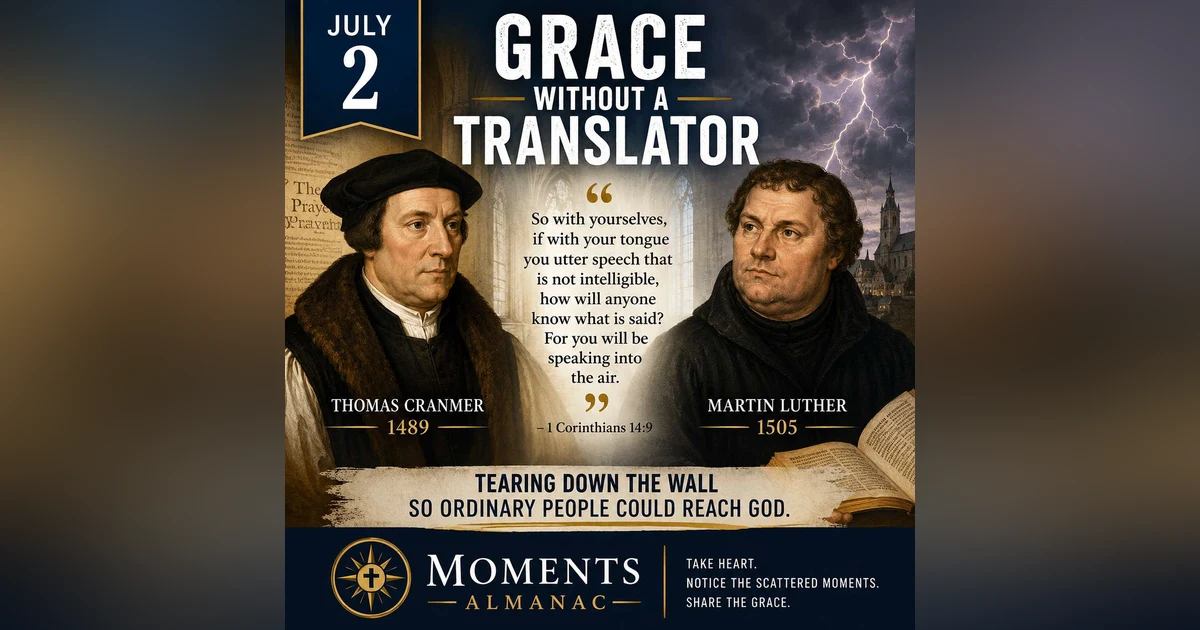


On this episode of Moments Almanac, we explore two lives forever connected by one remarkable truth: God's grace was never meant to require a translator.
On July 2, a young Martin Luther was thrown to the ground by a terrifying thunderstorm that changed the course of his life. Sixteen years earlier, Thomas Cranmer was born in England, destined to become the quiet architect of worship in the English language. Though their journeys were vastly different, both men helped tear down barriers that kept ordinary people from hearing—and understanding—the good news of Jesus Christ.
Discover the story behind Luther's search for peace, Cranmer's gift of English worship, and why their legacy still matters for every believer today.
Scripture: 1 Corinthians 14:9 (ESV)
"If with your tongue you utter speech that is not intelligible, how will anyone know what is said?"
Take heart. Notice the scattered moments. Share the grace.
Welcome to Moments Almanac for July 2nd, 2026. Two ordinary men born 16 years apart. Neither one set out to change the church. Neither one imagined that millions of people would one day speak their names. In 1489, a boy named Thomas Cramner was born in a modest family in Nottinghamshire, England. There was only enough land for the oldest son. Thomas and his younger brother were destined for the church. He grew into a quiet scholar, the sort of man who preferred a library to a courtroom and a book to an argument. No one looking at young Thomas Cramner would have called him a revolutionary. Sixteen years later, on July 2nd, 1505, a 21-year-old law student named Martin Luther was walking back from Erford after visiting his parents near the village of Stodernheim. The sky exploded. Thunder. Lightning struck so close to him it threw him to the ground. Terrified, Luther cried out, St. Anne help me. I will become a monk. Two weeks later, he kept the promise. His father was furious. His legal career was over before it had begun. No one watching that young frightened man stumble through the storm would have ever called him a revolutionary either. Yet God was already writing a story neither man could see. Luther's storm carried him into a monastery where he spent years trying to earn God's favor. He fasted, prayed, confessed, punished himself, but peace always seemed beyond reach. Then while studying Paul's letter to the Romans, he discovered something that changed everything. Righteousness was not a prize to climb toward, it was a gift. Grace was not earned, it was received by faith. Cranmer's road was slower. He served kings, worked through policies, made compromises he would later regret. But over the years one conviction became impossible for him to ignore. People cannot pray what they cannot understand. For centuries much of Christian worship had remained locked away in Latin, so Cranmer helped place the scriptures into English and eventually gave the church something remarkable. A prayer book ordinary people could actually pray. Farmers, tradesmen, children, mothers, the tavern keeper's daughter. People no longer needed someone else to understand the words for them. As Paul wrote, if your speech is not intelligible, how will anyone know what is said? The gospel was never meant to be hidden behind unfamiliar words. Neither man received an easy ending. Luther endured years of spiritual torment before finally finding peace in Christ. Cranmer's final chapter was even harder. Under pressure from Queen Mary, he signed a recantation, denying many of the convictions he had come to believe. But when he stood at the stake, he withdrew those words. Then he stretched into the flames the hand that had signed the recantation, declaring that it had offended. Two imperfect men, one interrupted by a storm, one shaped through the decades of political turmoil. Yet both spent their lives tearing down a wall between ordinary people and God, not by inventing a new gospel, but by making the old gospel understandable. As the church would later sing Luther's great hymn, A Mighty Fortress is our God, a bulwark, never failing. Every generation faces the same calling, not merely to defend the truth, but to speak it so clearly that people can hear the voice of Christ for themselves. Grace was never meant to require a translator. That's today's Moments Almanac. I hope you'll join me tomorrow. Until then, take care. Notice the scattered moments and share the grace.


